Just fry it all in oil with 油で炒める
Vocabulary Explanation: Collocations for cooking
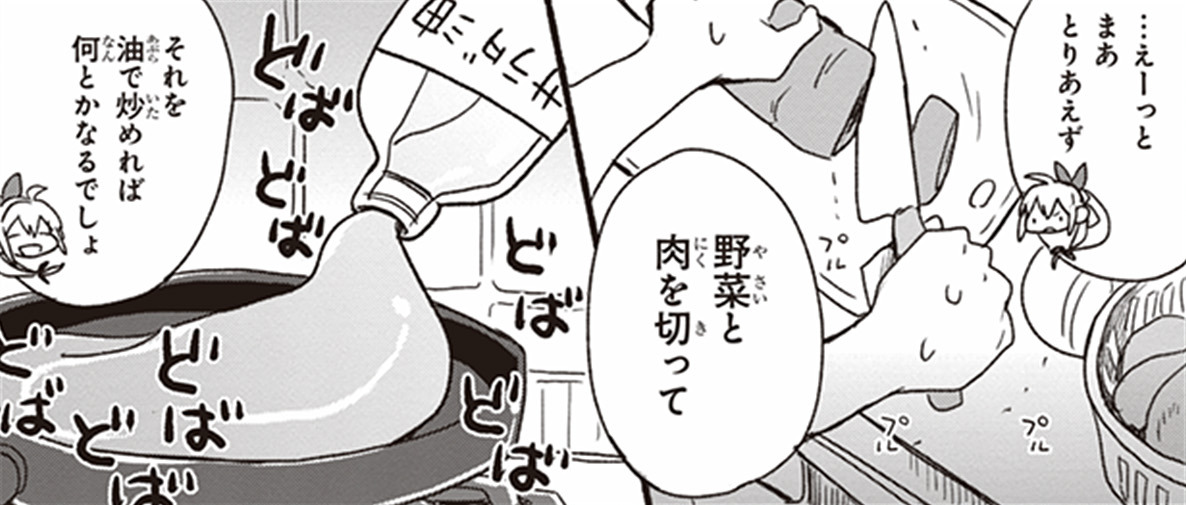
Neko puts on an apron and declares that today she’ll make a meal all by herself. She has rehearsed it in her head and pictures a perfect dish, one tasty enough to show up “that shrine maiden”.
- 禰子:
- 「…えーっと まあ とりあえず 野菜と肉を切って」
- “…Um, well, for now, I'll cut the vegetables and meat...”
- 「それを油で炒めれば何とかなるでしょ」
- “...and if I fry it all in oil, it'll work out somehow, right?”
Key Points
- 炒める means to cook food in a pan with oil, stirring or tossing it. It covers both stir-frying and sautéing. 野菜炒め, stir-fried vegetables with a bit of meat, is exactly the dish Neko is improvising.
- で marks the means: the oil is what the food cooks in. You’ll also hear バターで炒める, “sauté in butter”.
- Deep-frying is a different verb, 揚げる. Neko pours oil in by the glug, as if she’s about to deep-fry, and that’s where the trouble starts.
- 切る is the general verb for cutting food. The て-form 切って links her steps in order: cut first, then fry.
- それ in the next line points back to the cut vegetables and meat.
- 炒めれば is the ば-conditional of 炒める: “if I stir-fry it”. The ば clause names what she thinks will make everything turn out all right.
- 何とかなる means things will somehow work out. It’s an optimistic shrug, often said when someone has no clear plan.
- でしょ is a casual でしょう. Said to herself, it’s a confident guess: “surely, right?”
- Her image training was perfect, but at the cutting board she hesitates. えーっと buys time, まあ settles for something, and とりあえず means “for now” or “to start with”. She goes for the simplest plan she can think of.
Vocabulary
まあ (Well)
まあ is a soft “well” that eases into what the speaker says, or accepts something half-heartedly. It also shows mild surprise, like “oh my”.
とりあえず (For now)
とりあえず describes doing something first, as a temporary step, before dealing with the rest.
野菜 (Vegetables)
野菜 is the general word for plants grown to be eaten, such as cabbage, carrots, and onions.
肉 (Meat)
肉 is meat, the flesh of animals eaten as food. It also means the flesh of the body or the soft part of a fruit.
切る (To cut)
切る is to cut something. It also means to end a phone call or turn something off.
それ (That)
それ points to something near the listener, or to something just mentioned.
油 (Oil)
油 is oil, such as cooking oil or fuel oil. In talk about food, it also covers the fat or grease in a dish.
炒める (To stir-fry)
炒める means to cook food in a pan with a little oil, stirring or tossing it, as in stir-frying or sautéing. 野菜炒め is stir-fried vegetables.
何とかなる (To work out somehow)
何とかなる means that things will somehow turn out all right, even without a clear plan. It is often said to reassure someone or to shrug off a worry.
See Also
- Vocabulary: Collocations for cooking
- Grammar: Hypothetical condition with 〜ば
- Grammar: Presuming with 〜だろう and 〜でしょう