Just out of the fryer with 〜たとこだ
Grammar Explanation: Timing of an action with 〜ところだ
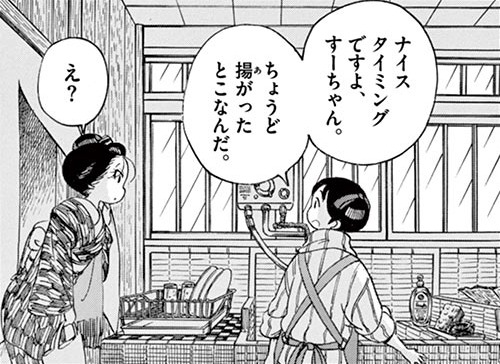
Kenta, a friend from back home, has told Sumire that he’s taking a job in Kyoto and staying. Sumire is thrilled, then scolds herself for it, since he must have made some hard choices. She comes home worn out from holding back a grin, and Kiyo leans out to welcome her back.
- キヨ:
- 「ナイスタイミングですよ、すーちゃん。」
- “Nice timing, Su-chan.”
- 「ちょうど揚がったとこなんだ。」
- “It's just come out of the fryer.”
- すみれ:
- 「え?」
- “Huh?”
Key Points
- A た-form verb plus ところだ marks the moment right after an action ends. とこ is the casual, clipped form of ところ.
- ちょうど often comes with it. Here it stresses the timing: the food finished frying the moment Sumire arrived.
- 揚げる is “to deep-fry”, something a cook does. 揚がる is its intransitive partner, “to be done frying”.
- Kiyo uses 揚がる to talk about the food, not about herself. It’s ready, and it’s still hot.
- なんだ is のだ after ところ, a noun. Kiyo uses it to explain her first line: the timing is nice because the food is fresh.
- Kiyo usually talks to Sumire in plain speech. ナイスタイミングですよ borrows a polite, announcer-like tone for fun, and she drops back to plain speech in the next line.
Vocabulary
ナイス (Nice)
ナイス, from English “nice”, praises something as good or well done. It often comes before another loanword, as in ナイスタイミング, “nice timing”.
タイミング (Timing)
タイミング is the timing or moment when something happens.
ちょうど (Just)
ちょうど describes something that fits exactly, or happens at just the right time.
揚がる (To be deep-fried)
揚がる means food is done deep-frying and ready to come out of the oil. It’s the intransitive partner of 揚げる, “to deep-fry”. Written 上がる, the same verb means to rise or go up.
とこ (Place)
とこ is a casual, shortened form of ところ, “place”.
See Also
- Grammar: Timing of an action with 〜ところだ
- Grammar: Reasoning with 〜のだ
- Grammar: How casual contractions work