Keeping us here on purpose with 留まらせる
Vocabulary Explanation: Stopping, fastening, and staying over with とまる
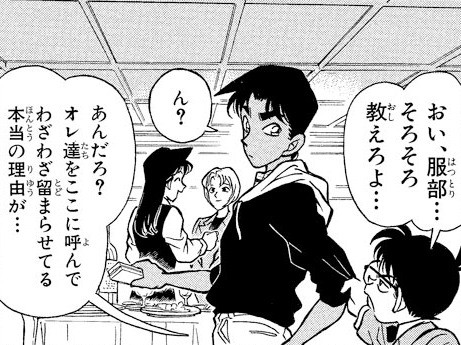
Heiji had his father, the head of the Osaka police, recommend Kogoro to the Nagato Group’s chairman. The job turned out to be finding the chairman’s childhood first love, hardly work for a famous detective, and Conan has noticed security guards all over the mansion. Now, at the chairman’s birthday dinner, he tugs at Heiji’s shirt.
- コナン:
- 「おい、服部…そろそろ教えろよ…」
- “Hey, Hattori... Time you told me...”
- 平次:
- 「ん?」
- “Hm?”
- コナン:
- 「あんだろ?オレ達をここに呼んでわざわざ留まらせてる本当の理由が…」
- “There's something, right? The real reason you called us here and went out of your way to keep us here...”
Key Points
- 留まる has two readings. Read とまる, it’s being fastened in place. Read とどまる, as the furigana shows here, it’s staying or remaining somewhere instead of leaving.
- Spending the night is 泊まる. とどまる says nothing about the night, only that someone stays put.
- 留まらせる is the causative of とどまる: “make someone stay”. Heiji is the subject, and オレ達を marks Conan and the others as the ones kept there.
- Casual speech shortens 〜ている to 〜てる, so 留まらせている becomes 留まらせてる: Heiji is still keeping them there.
- わざわざ means doing something on purpose, at some trouble, when you didn’t need to. Conan uses it to say Heiji’s arrangements are too deliberate to be innocent.
- あんだろ is casual あるんだろう, “there is one, isn’t there?” The る of ある turns into ん before the ん of んだ.
- Conan says the verb first and adds its subject at the end: 本当の理由が, “the real reason”. In normal order, the line would be オレ達をここに呼んでわざわざ留まらせてる本当の理由があんだろ? Saying あんだろ first presses Heiji for an answer.
- 教えろ is the plain imperative of 教える, “tell”. With そろそろ, “it’s about time”, Conan makes it clear he’s done waiting.
Vocabulary
| Word | English | Meaning |
|---|---|---|
| そろそろ | Soon | そろそろ describes something about to happen, or a time when it is about right to do something. |
| 教える | To teach | 教える is to teach a skill or subject. It also means to tell someone information. |
| ある | To exist | ある is to exist or be in a place, for things and plants rather than people or animals. It also means to have something, or for an event to take place. |
| オレ | I | オレ is a katakana spelling of おれ, a casual, masculine word for “I”. It is also written 俺. |
| 達 | Plural suffix for people | 達 follows a word for a person to mean that person and others, as in 僕達, “we”, or 子供達, “children”. It is often written in kana as たち. |
| ここ | Here | ここ is the place where the speaker is. |
| 呼ぶ | To call | 呼ぶ is to call out to someone, call someone over, or call something by a name. |
| わざわざ | Specially | わざわざ describes going out of one’s way to do something, taking extra trouble. |
| 留まる | To be fastened; to stay | 留まる is for something to be held in place, such as by a pin or a screw. Read とどまる, it means to stay or remain somewhere instead of moving on. |
| 本当 | Truth | 本当 is the truth, as opposed to a lie or a joke. ほんとう? asks “really?” |
| 理由 | Reason | 理由 is why something is so or was done. 理由がある is to have a reason, and 理由もなく is for no reason. |
See Also
- Vocabulary: Stopping, fastening, and staying over with とまる
- Grammar: Making and letting with 〜せる・〜させる
- Grammar: How casual contractions work
- Grammar: Presuming with 〜だろう and 〜でしょう
- Grammar: The plain imperative
- Kanji: Matching and appropriateness with 当
- Kanji: Origins and main things with 本
- Kanji: Reaching and attaining with 達