Kindred spirits in golf with 気が合う
Idiom Explanation: Getting along with 気が合う
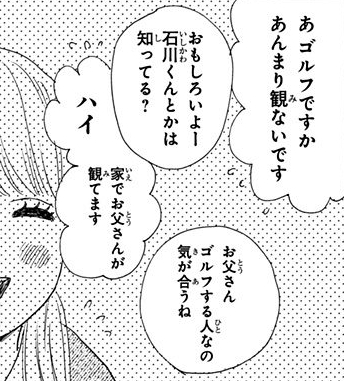
Takeo’s girlfriend Rinko visits to study with him, but Takeo’s parents take turns interrupting them to get to know her better. Takeo’s father, Yutaka, asks if she watches golf.
- 凛子:
- 「あ ゴルフですか。あんまり観ないです」
- “Ah, golf? I don't watch a lot of it.”
- 豊:
- 「おもしろいよー!石川くんとか知ってる?」
- “It's fun! Do you know about Ishikawa-kun?”
- 凛子:
- 「ハイ。家でお父さんが観てます」
- “I do. My father watches it at home.”
- 豊:
- 「お父さん ゴルフする人なの。気が合うね」
- “So your dad's a golf guy. We're kindred spirits, eh?”
- Literal: “Your dad is a person who plays golf. Our feelings match, huh?”
Key Points
1気が合う = “to get along” / “to be compatible”
- Literally: 気 (feeling/temperament) + が + 合う (to match/fit together).
- Used for people who share interests, have compatible personalities, or naturally “click”.
- Here: shared interest in golf makes Yutaka and Rinko’s father 気が合う (kindred spirits).
2Discovery sequence: confirming with なの
- お父さん ゴルフする人なの “So your dad’s a golf guy.”
- The なの at the end confirms/explains what Yutaka just realized from her answer.
- Then he draws the conclusion: 気が合うね.
3ね adds friendly agreement-seeking
- The ね invites Rinko to acknowledge the connection between the fathers.
- Creates a warm, inclusive feeling: “we’re kindred spirits, aren’t we?”
- 君 is an honorific suffix used after names, typically for boys or men. It’s commonly used by teachers addressing male students, by friends among young people, or by superiors addressing junior colleagues, and can also be used for girls in childhood or casual contexts.
Vocabulary
知る (To know)
知る means to learn or come to know a fact or person. In the form 知っている, it describes already knowing.
See Also
- Idiom: Getting along with 気が合う
- Vocabulary: Observing with 観る
- Grammar: Reasoning with 〜のだ
- Future entry: Seeking agreement with ね
俺物語!! © its respective creators. It is used here for educational commentary.