Kneading dough for the jam stall with 捏ねる
Vocabulary Explanation: Collocations for cooking
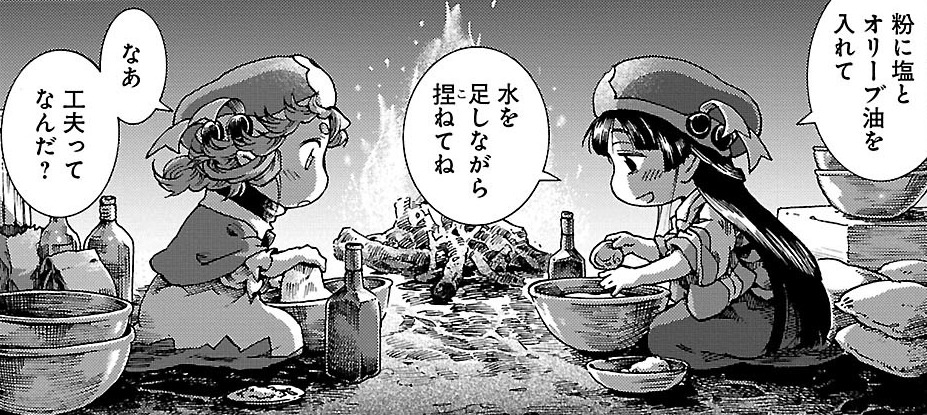
Mikochi is making a jam-and-bread set to sell at the festival, and she and Hakumei are cooking outdoors. They layered raspberries and sugar in a big pot, and when Hakumei worried the jam would come out too sweet, Mikochi said she had a little trick in mind. With the berries left to sit, Mikochi says it’s time to get the bread ready.
- ミコチ:
- 「粉に塩とオリーブ油を入れて」
- “Put salt and olive oil in the flour...”
- 「水を足しながら捏ねてね」
- “...then knead it while you add water.”
- ハクメイ:
- 「なあ」
- “Hey.”
- 「工夫ってなんだ?」
- “What's this trick of yours?”
Key Points
- 捏ねる means to knead dough by hand, pressing and folding it until it holds together. The usual object is 生地, dough, as in 生地を捏ねる. Mikochi leaves the object out because the bowl of flour is right in front of Hakumei.
- 捏 isn’t a jōyō kanji, so the word is usually written in kana as こねる. The manga gives the reading in furigana.
- The same verb shows up in だだをこねる, “to throw a tantrum”, and 理屈をこねる, “to quibble”.
- 足す means to add more of something, often to top up what’s already there. Here the water goes in a little at a time.
- 〜ながら attaches to the verb’s ます stem, 足し, and means doing two things at once. The main action is the one after it: Hakumei kneads, and adds water as she goes.
- 粉に塩とオリーブ油を入れて uses に for where the salt and oil go, と to list them, and the て form to move on to the next step.
- Mikochi ends on 捏ねてね, a casual request. The て form alone asks someone to do something, and ね softens it, like “okay?” at the end of an instruction.
- 工夫 is a clever idea or a twist on the usual way of doing something. Hakumei is asking about the ひと工夫 Mikochi mentioned when Hakumei worried the jam would be too sweet.
- って here marks the topic, like は, and casually brings up something just mentioned. なんだ is Hakumei’s plain, blunt way of asking “what is it?”.
Vocabulary
粉 (Powder; flour)
粉 is powder, anything ground into fine grains. In the kitchen it usually means flour, as in パンの粉, the flour for bread.
オリーブ油 (Olive oil)
オリーブ油 is olive oil, the oil pressed from olives. It’s also called オリーブオイル.
入れる (To put in)
入れる is to put something inside something else. It also means to let someone in, or to make tea or coffee.
水 (Water)
水 is water, especially cold water.
足す (To add)
足す means to add something to what’s already there, such as more water to a mixture, or one number to another.
捏ねる (To knead)
捏ねる means to knead dough or clay with the hands until it holds together. Usually written in kana as こねる, it also appears in だだをこねる, “to throw a tantrum”, and 理屈をこねる, “to quibble”.
工夫 (Ingenuity)
工夫 is thinking up a clever way to do something better, or the clever touch itself. 工夫する is to put thought into how a thing is made or done.
See Also
- Vocabulary: Collocations for cooking
- Grammar: Concurrent events with 〜ながら
- Grammar: Connecting actions with 〜て・〜で
- Kanji: Entering and putting in with 入