Knocked out in the preliminaries with 予選
Kanji Explanation: Choosing and selection with 選
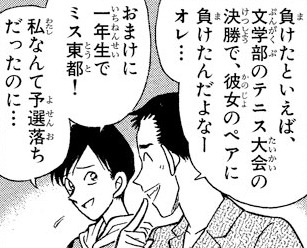
Kogoro, Ran, Sonoko, and Conan are guests at a villa where a university mystery club is celebrating member Asami’s birthday. The club’s vice president adds that the party also honors Asami’s novel, which just won a newcomer award. Morimoto, whose own story reached the final round of judging, says he can’t complain about losing to the club’s rising star.
- 野口:
- 「負けたといえば、文学部のテニス大会の決勝で、彼女のペアに負けたんだよなーオレ…」
- “Speaking of losing, I lost to her doubles team in the final of the literature department's tennis tournament...”
- 宮崎:
- 「おまけに一年生でミス東都!私なんて予選落ちだったのに…」
- “On top of that, she was Miss Toto as a freshman! I didn't even make it past the preliminaries...”
Key Points
- 予選 combines 予, beforehand, with 選, selection. It is the round that picks who goes on to the main event.
- 予選落ち adds 落ち from 落ちる, to fall or fail. It means being eliminated in the preliminaries.
- The opposite path is 予選通過, getting through the preliminaries, then on to the 決勝, the final.
- なんて after 私 downplays the speaker, “someone like me”.
- The trailing のに sets her failure against Asami’s success, with a touch of envy.
- 〜といえば means “speaking of ~”. Noguchi picks up the word 負ける from Morimoto’s line and adds his own loss to Asami.
- In 負けたんだよなーオレ, the subject オレ comes at the end as an afterthought. Spoken Japanese does this a lot.
- おまけに means “on top of that”. Miyazaki adds one more achievement to the list of Asami’s wins.
Vocabulary
| Word | English | Meaning |
|---|---|---|
| 負ける | To lose | 負ける is to lose a game, fight, or contest. |
| 文学部 | Literature department | 文学部 is a university’s faculty or department of literature, which often covers the humanities in general. |
| テニス | Tennis | テニス is the sport of tennis. |
| 大会 | Tournament | 大会 is a large organized event such as a tournament, competition, or convention. |
| 決勝 | Final match | 決勝 is the last match of a tournament, the one that decides the champion. |
| 彼女 | She | 彼女 points to a woman or girl already mentioned. It is also the usual word for a girlfriend. |
| ペア | Pair | ペア is a pair of two people or things, such as a doubles team in tennis or a matching set. |
| オレ | I | オレ is a katakana spelling of おれ, a casual, masculine word for “I”. It is also written 俺. |
| おまけに | On top of that; to make matters worse | おまけに adds one more point to what was just said, often one more complaint: “on top of that” or “to make matters worse”. It is common in speech and usually written in kana. |
| 一年生 | First-year student | 一年生 is a student in the first year of a school or university. It can also mean a beginner or newcomer in any role. |
| 私 | I | 私 means “I” or “me”. It is the standard first-person pronoun in polite speech and is also common in casual speech among women. |
| なんて | Such a thing as | なんて follows a word to treat it lightly or with surprise: “things like” or “such a thing as”. At the start of a phrase, it means “what a…!” |
| 予選 | Preliminary round | 予選 is the early round of a contest that decides who goes on to the main event. |
| 落ちる | To fall | 落ちる is to drop from a higher place. It also means for a fire to die down, or to fail an exam. |
See Also
- Kanji: Choosing and selection with 選
- Grammar: Even though with 〜のに
- Kanji: Learning and schooling with 学
- Kanji: Meeting and joining with 会
- Kanji: Patterns and writing with 文
- Kanji: Privacy and self with 私
- Kanji: Sections and departments with 部
- Kanji: Women and femininity with 女