Knowing you, there was a reason with 〜のことだから
Grammar Explanation: Referring to a person with 〜のこと
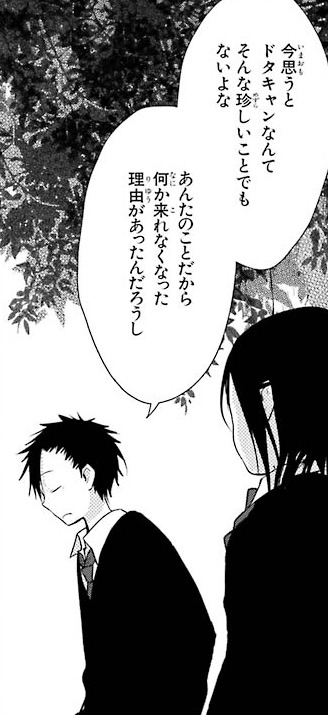
Kujo, Fujimiya’s childhood friend, has transferred to her school. He tells her that before he moved away, she promised to meet him at the park one Sunday evening, but she never came, though he waited until he had to leave for Hokkaido. He felt betrayed, since she wasn’t the type to break a promise. Fujimiya doesn’t remember any of it, and Kujo shrugs that he was just a kid back then.
- 九条:
- 「今思うと ドタキャンなんて そんな珍しいことでもないよな」
- “Looking back, canceling at the last minute isn't all that unusual.”
- 「あんたのことだから 何か来れなくなった理由があったんだろうし」
- “Knowing you, there must have been some reason you couldn't come.”
Key Points
- Person + のことだから bases a guess on what that person is like: “knowing you”. The rest of the sentence is the guess.
- The guess can be good or bad. Here it’s kind: Fujimiya keeps her promises, so she must have had a reason.
- 来れる is a casual 来られる, “can come”. 〜なくなる means “become unable”, so 来れなくなった is “couldn’t come after all”.
- んだろう is a confident guess, “must have”. し gives it as one reason among others, softening the line.
- ドタキャン is slang for 土壇場でキャンセル, “canceling at the last minute”.
- 今思うと means “thinking about it now” or “looking back”.
Vocabulary
今 (Now)
今 is the present moment, or these days.
思う (Think)
思う is to have a thought, feeling, belief, or hope about something.
ドタキャン (Last-minute cancellation)
ドタキャン is canceling plans at the last minute. It is a casual shortening of 土壇場キャンセル.
なんて (Such a thing as)
なんて follows a word to treat it lightly or with surprise: “things like” or “such a thing as”. At the start of a phrase, it means “what a…!”
そんな (Like that)
そんな describes something like the thing just mentioned. Said alone, it shows shock or denial: “no way!”
珍しい (Unusual)
珍しい describes something rare or out of the ordinary. Said about what a person does, it can mean “that’s not like you”.
こと (Thing)
こと is an abstract thing, matter, or fact, as opposed to a physical object. It also turns a verb phrase into a noun, as in 見たことがある. It is also written 事.
あんた (You)
あんた is a casual, blunt word for “you”. Between close people it sounds familiar, but toward others it can sound rude.
何か (Something)
何か means something or anything. It can also introduce an uncertain question, as in “Is something wrong?”
来る (To come)
来る means to come or move toward the speaker or the place being discussed.
なる (To become)
なる is to change into a different state or become something. It also means something turns out a certain way. It is also written 成る.
ある (To exist)
ある is to exist or be in a place, for things and plants rather than people or animals. It also means to have something, or for an event to take place.
See Also
- Grammar: Referring to a person with 〜のこと
- Grammar: Presuming with 〜だろう and 〜でしょう
- Grammar: Able to do with 〜れる・〜られる
- Kanji: Now and the present with 今