Koto lessons with 稽古
Vocabulary Explanation: Training with 稽古
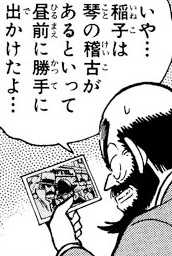
Hired to confirm whether a client’s wife is having an affair, Kogoro reveals a candid photo he took of the wife with another man. The client mentions he let his staff take a break so they wouldn’t know about Kogoro’s visit. Kogoro asks if that includes the client’s wife.
- 伝次郎:
- 「いや… 稲子は琴の稽古があるといって昼前に勝手に出かけたよ」
- “No... Ineko said she had a koto lesson and went out on her own before noon.”
In this scene, 稽古 is used to describe a koto lesson. This reflects the traditional and cultural aspect of the activity, as koto is a classical Japanese instrument.
The use of 稽古 instead of 練習 emphasizes the structured and disciplined nature of the lesson, as well as its connection to Japanese heritage.
Key Points
- In this panel, 稽古 is not just casual “practice”; it suggests a structured lesson in a traditional art.
- That fits 琴 especially well, since koto is a classical instrument and 稽古 carries a more traditional nuance than 練習.
- 「琴の稽古があるといって」 means she said, “I have a koto lesson”, and that is presented as the reason she left.
- 勝手に often implies doing something independently or without checking with others first, not merely “freely”.
- Here it adds a slightly critical nuance: she just went out by herself before noon.
Vocabulary
稽古 (Practice)
稽古 means practice or training, especially in martial arts, performing arts, and other traditional disciplines. It can also mean a lesson or training session in one of those arts.
言う (To say)
言う means to say or tell. It can also mean to call something by a particular name.
昼前 (Before noon)
昼前 means late morning or just before noon.
See Also
- Vocabulary: Training with 稽古
- Future entry: Past tense with 〜た・〜だ
- Grammar: Marking the topic with は and も
- Kanji: Daytime and noon with 昼
- Kanji: Oldness and antiquity with 古