Leave the vegetables to me with 野菜を切る
Vocabulary Explanation: Collocations for cooking
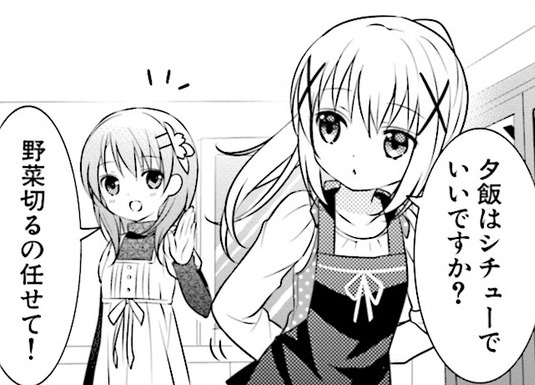
Cocoa has just moved in as a lodger with Chino’s family at the Rabbit House café. After closing, she suggested the two of them make dinner together. Chino said she could manage on her own, but Cocoa joined her in the kitchen.
- チノ:
- 「夕飯はシチューでいいですか?」
- “Is stew okay for dinner?”
- ココア:
- 「野菜切るの任せて!」
- “Leave cutting the vegetables to me!”
Key Points
- 切る is the general verb for cutting, and 野菜を切る is the everyday way to say you’ll chop the vegetables. Specific cuts are nouns built on 切り, such as みじん切り, “minced”.
- In casual speech the を drops out, as it does here: 野菜切る.
- の turns the phrase 野菜切る into a noun, “cutting the vegetables”, so it can be the thing being handed over. The full form would be 野菜を切るのは私に任せて.
- 任せる means to entrust a task to someone. 任せて! by itself is a confident “leave it to me!”, and naming the task first says which job you’re claiming.
- Noun + でいい asks whether something will do. Chino uses it to check the menu with Cocoa before they start cooking.
- 夕飯 means the evening meal. Chino speaks politely even to Cocoa, so she ends with ですか.
Vocabulary
夕飯 (Dinner)
夕飯 means dinner or the evening meal. It sounds more domestic and conversational than 夕食.
シチュー (Stew)
シチュー is a stew, often a creamy Japanese-style one with vegetables and meat.
いい (Good)
いい describes something good, nice, or fine. It can also mean “okay” or “that’s enough”. Its other forms come from よい, as in よくない and よかった.
野菜 (Vegetables)
野菜 is the general word for plants grown to be eaten, such as cabbage, carrots, and onions.
切る (To cut)
切る is to cut something. It also means to end a phone call or turn something off.
任せる (To leave to someone)
任せる is to entrust a task or decision to someone and let them handle it. 任せて! is a confident “leave it to me!”
See Also
- Vocabulary: Collocations for cooking
- Grammar: Requests with 〜てください and 〜てくれ
- Grammar: Permission to do with 〜てもいい