Leaving a door unlocked with 〜っぱなし
Grammar Explanation: Leaving something as-is with 〜っぱなし
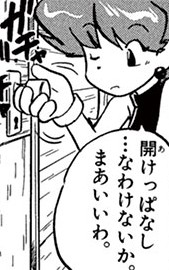
Blue tries to sneak into Masaki’s cottage, but the door is locked.
- ブルー:
- 「開けっぱなし…なわけないか。まあいいわ。」
- “There's no way it'd be left unlocked. Well, that's fine.”
- Literal: “Left open... there's no way, huh. Well, fine.”
Key Points
1開けっぱなし means left open
- 開けっぱなし describes a door left in the opened/unlocked state after someone opened it.
- The focus is on the unchanged state, not the act of opening itself.
2なわけないか rejects the possibility
- Blue briefly imagines the door might be left unlocked, then says there is no way that would be true.
- か at the end softens it into a self-correction: “I guess not.”
3The phrase is useful for careless states
- 〜っぱなし often appears with things left on, open, out, or unfinished.
- In this scene it fits because she is hoping for an easy way into the cottage.
Vocabulary
| Word | English | Meaning |
|---|---|---|
| 開けっぱなし | Left open | 開けっぱなし describes a door or window left open. |
| わけ | Reason | わけ is a reason or meaning. It also appears in grammar patterns such as わけがない, “there’s no way”, and わけにはいかない, “can’t very well”. |
| ない | Not | ない means something does not exist or someone does not have it. After a verb, it makes the verb negative. It is also written 無い. |
| まあ | Well | まあ is a soft “well” that eases into what the speaker says, or accepts something half-heartedly. It also shows mild surprise, like “oh my”. |
| いい | Good | いい describes something good, nice, or fine. It can also mean “okay” or “that’s enough”. Its other forms come from よい, as in よくない and よかった. |
See Also
- Grammar: Leaving something as-is with 〜っぱなし
ポケットモンスタースペシャル © its respective creators. It is used here for educational commentary.