Leaving right after a drink with 〜たばっか
Grammar Explanation: Just happened with 〜た+ばかり
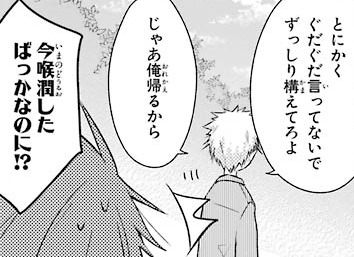
Fujimiya’s mother has asked Hase to meet her at the park on Sunday, and he’s anxious about what she wants. On Saturday he calls Kiryuu out to the same park to talk it over. Kiryuu, thirsty and without his wallet, gets Hase to buy him a drink. Hase admits he could have just phoned, but he wanted Kiryuu to set him straight in person.
- 桐生:
- 「とにかく ぐだぐだ言ってないで ずっしり構えてろよ」
- “Anyway, quit whining and hold steady.”
- Literal: “Anyway, without going on and on, stay heavily in your stance.”
- 「じゃあ俺帰るから」
- “Okay, I'm heading home.”
- Literal: “Well then, I'm going home.”
- 長谷:
- 「今喉潤したばっかなのに!?」
- “You only just wet your whistle, and you're leaving?!”
- Literal: “Even though you only just moistened your throat now?!”
Key Points
- The た-form 潤した plus ばっか says the action happened a moment ago. 今 “just now” makes the timing explicit.
- ばっか is a casual contraction of ばかり, by way of ばっかり.
- 喉を潤す, “to moisten the throat”, means to have a drink. Hase drops the を, as casual speech often does.
- ばかり works like a noun here, so のに attaches with な: ばっかなのに.
- Hase leaves the rest unsaid. The missing part is something like “and you’re already leaving?”
- 言ってないで is 言っていないで, “without going on saying”. 〜ないで tells Hase to stop doing something and do something else instead.
- ぐだぐだ言う means to whine or go on and on about something.
- 構えてろ is 構えていろ with the い dropped, a blunt command to stay in a state.
- 構える is to take a stance. The usual phrase is どっしり構える, to stay calm and unshaken. Kiryuu’s ずっしり means heavy, so the idea is to stand firm.
- Ending on から announces his departure as a done deal and leaves “so see you” unsaid.
Vocabulary
とにかく (Anyway)
とにかく sets other matters aside to focus on the main point: “in any case”.
ぐだぐだ (On and on)
ぐだぐだ describes doing something in a drawn-out, tiresome way. With 言う, it means to grumble or go on and on about something. It can also describe someone lazing around, or something that has turned slack and messy.
言う (To say)
言う means to say or tell. It can also mean to call something by a particular name.
ずっしり (Heavily)
ずっしり describes something that feels solidly heavy, such as a bag that weighs on the hand. It can also describe a weight that sinks in deeply, like a responsibility.
構える (To take a stance)
構える means to take a stance or get ready, such as holding a camera or weapon at the ready. It can also mean to brace yourself mentally, to act stiff and formal, or to set up a house or shop.
俺 (I)
俺 means “I” or “me”. Men commonly use it in casual speech, and it sounds rougher and more masculine than 私 or 僕.
帰る (To go home)
帰る is to go back home or to where you came from.
今 (Now)
今 is the present moment, or these days.
喉 (Throat)
喉 is the throat. 喉が渇く means to be thirsty, and 喉 can also refer to someone’s singing voice.
潤す (To moisten)
潤す means to moisten or wet something. 喉を潤す, “to wet the throat”, means to have a drink. It can also mean to enrich or benefit, as when an industry brings money to a town.
See Also
- Grammar: Just happened with 〜た+ばかり
- Grammar: Even though with 〜のに
- Grammar: How casual contractions work
- Grammar: The plain imperative
- Grammar: Ongoing actions and resulting states with 〜ている
- Grammar: Because with 〜から
- Kanji: Now and the present with 今