Leaving the mountain at the shortest route with 最短
Kanji Explanation: Shortness and brevity with 短
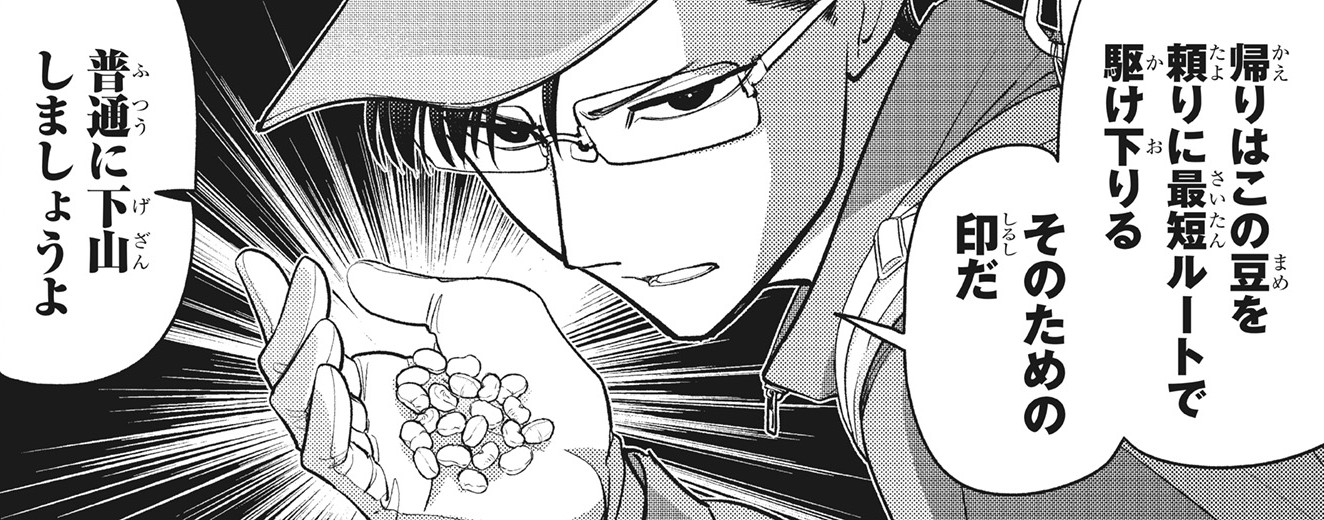
Kumada takes a trip to the mountain, in hope that the bear living in his apartment will follow him there, then he can run away and leave the bear stranded behind. He has with him his employee Sanami, an expert on mountains, to act as a guide. During their hike, Sanami asks Kumada why he’s placing beans on the ground as they go.
- 熊田:
- 「帰りはこの豆を頼りに最短ルートで駆け下りる」
- “On the way back, I'll use these beans as a guide and run down by the shortest route.”
- 「そのための印だ」
- “That's what the markers are for.”
- 砂波:
- 「普通に下山しましょうよ」
- “Let's just go down the mountain normally.”
Key Points
- 最 adds the sense of “most” to 短, “short”. Here 最短 describes the route’s distance.
- In 最短ルートで, で marks the route Kumada plans to take down the mountain.
- The pattern Ⓐを頼りに means doing something with Ⓐ as one’s support or guide. Kumada plans to follow the beans he has left behind.
- 帰りは sets the topic as the return trip. The final verb 駆け下りる means “run down”, describing what he will do then.
- そのため means “for that purpose”, and の connects it to 印, “markers”. The beans are markers to help him find his way down.
- Sanami wants them to descend normally. Here 普通に describes how to go down, rather than how often they do it.
- 下山する means “descend a mountain”. Its polite volitional form, 下山しましょう, makes a suggestion to do it together.
- The final よ adds a nudge to the suggestion, giving the line the feel of “Let’s just go down normally.”
Vocabulary
帰り (Return trip)
帰り means returning or the journey back. It often refers to the way home after an outing, school, or work.
この (This)
この means “this” or “these” and comes directly before a noun. It points to something near the speaker or something the speaker is referring to in the conversation.
豆 (Bean)
豆 means a bean or pea, especially one used as food.
頼り (Reliance)
頼り means reliance or someone or something one depends on.
最短 (Shortest)
最短 means shortest in distance or duration.
ルート (Route)
ルート means a route or path to a destination.
駆け下りる (To run down)
駆け下りる means to run down a slope, stairs, or another descent.
印 (Mark)
印 means a mark used to identify something.
普通に (Normally)
普通に means normally or in the usual way.
下山 (Mountain descent)
下山 means descending a mountain. With する, it means to come or go down a mountain.
See Also
- Kanji: Shortness and brevity with 短
- Grammar: Volitional with 〜う・〜よう
- Future entry: Informing with よ