Leaving the room while Yukiko was out with 〜間
Grammar Explanation: During the same time with 〜間(に)
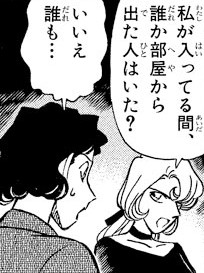
A murder victim was last heard from via phone call at 9PM. Her body was found outside later that night. Yukiko was in the main room with everyone except when she was bathing.
- 有希子:
- 「私が入ってる間、誰か部屋から出た人はいた?」
- “While I was in the bath, was there anyone who left the room?”
- Literal: “During the time I was in, was there anyone who left the room?”
- 広美:
- 「いいえ誰も…」
- “No, no one...”
Key Points
- Here 私が入ってる間 means “while I was in the bath”.
- It marks the time span during which another event might have happened.
- The full form is 入っている間.
Vocabulary
| Word | English | Meaning |
|---|---|---|
| 私 | I | 私 means “I” or “me”. It is the standard first-person pronoun in polite speech and is also common in casual speech among women. |
| 入る | To enter | 入る is to go into a place, or for something to be inside. It also means to join a club or school. |
| 間 | While | 間 is the space or time between two things. 〜の間 means “while” or “during”. |
| 誰か | Someone | 誰か is some person who is not named or not known. |
| 部屋 | Room | 部屋 means a room separated from other spaces in a building. |
| 出る | To go out | 出る means to go out or leave. It is also used when something appears or is produced. |
| 人 | Person | 人 is a person, or people in general. It also means other people. |
| いる | To be | いる is to exist or be somewhere, for people and animals. After a て-form verb, it shows an ongoing action or a continuing state. |
See Also
- Grammar: During the same time with 〜間(に)
- Grammar: Past tense with 〜た・〜だ
- Grammar: Marking the subject with が
- Grammar: Marking the topic with は and も
- Kanji: Entering and putting in with 入
- Kanji: Going out and emerging with 出
- Kanji: People and persons with 人
- Kanji: Privacy and self with 私
- Kanji: Sections and departments with 部
- Kanji: Shelter and shops with 屋
- Kanji: Spaces and intervals with 間