Left to waste away in the Room of Darkness with 〜ばかりだ
Grammar Explanation: Nothing but with 〜ばかり
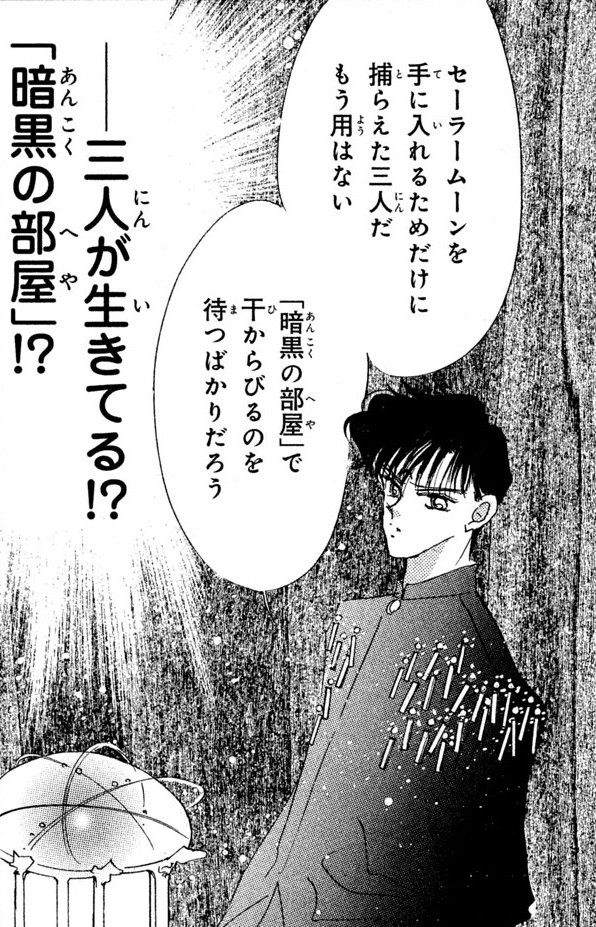
Sailormoon is searching the Black Moon clan’s maze-like castle for Mars, Mercury, and Jupiter, who were taken captive. She sensed them for an instant, then lost them. Weak and short of breath, she overhears Saphir talking with another member of the clan, who asks whether the three warriors are still alive.
- サフィール:
- 「セーラームーンを手に入れるためだけに捕らえた三人だ もう用はない」
- 「『暗黒の部屋』で干からびるのを待つばかりだろう」
- “We only took those three to get our hands on Sailormoon. We have no more use for them.”
- “I expect all that's left for them is to wait in the 'Room of Darkness' until they shrivel up.”
- うさぎ:
- 「三人が生きてる!? 『暗黒の部屋』!?」
- “The three of them are alive!? The 'Room of Darkness'!?”
Key Points
- After a verb’s dictionary form, ばかりだ can say that one step is all that remains. 待つばかりだ means “there’s nothing left but to wait”, like あとは待つばかりだ “all that’s left is to wait”.
- だろう replaces だ to make it a guess: “I expect”. Saphir hasn’t checked on the prisoners and doesn’t care to.
- Saphir is cold, not complaining, so this ばかり carries none of the criticism it often has in ゲームばかりしている.
- の turns 干からびる into a noun, “shriveling up”, and を makes it the thing being waited for. 〜のを待つ is “wait for something to happen”.
- 干からびる means “to dry up” or “to shrivel”. Said of people locked in a dungeon, it means wasting away until they die.
- で after 暗黒の部屋 marks where the waiting happens.
- ために gives the purpose, and だけ limits it: 手に入れるためだけに is “only for the purpose of getting hold of”.
- The whole clause セーラームーンを手に入れるためだけに捕らえた describes 三人. Saphir says the three are nothing more than people captured as bait.
- もう用はない means “we have no more use for them”. 用 is business or a use for something.
- 生きてる is the casual form of 生きている, with the い dropped. ている here describes a state: the three are alive.
- Sailormoon hears more than Saphir means to say. If her friends are left to waste away, they are still alive, and she now knows the name of the place where they are held.
Vocabulary
手に入れる (To obtain)
手に入れる means to get something into your possession, whether by buying, finding, or taking it.
ため (For)
ため is the purpose or benefit of something: 〜のため means “for the sake of” or “in order to”. It can also give a cause: “because of”. It is also written 為.
捕らえる (To capture)
捕らえる means to catch a person or animal so it can’t get away. It can also mean to grasp a meaning or to capture someone’s attention.
もう (Already)
もう means something has already happened, or with a negative, “no longer”. Before a number, it means “more”. Said alone, it shows frustration.
用 (Business)
用 is something that needs doing, such as an errand or a matter to take care of. In 用がある and 用はない, it is the reason for needing a person or thing, so もう用はない means “no more use for them”.
ある (To exist)
ある is to exist or be in a place, for things and plants rather than people or animals. It also means to have something, or for an event to take place.
部屋 (Room)
部屋 means a room separated from other spaces in a building.
干からびる (To shrivel up)
干からびる means to dry out completely and shrivel. It can also describe ideas or feelings that have lost all their freshness.
待つ (To wait)
待つ is to stay until someone comes or something happens.
生きる (To live)
生きる means to live or to be alive. It can also mean to make a living, or for something to stay alive in the sense of staying useful or effective.
See Also
- Grammar: Nothing but with 〜ばかり
- Grammar: Purpose and cause with 〜ために
- Grammar: Limiting with 〜だけ
- Grammar: Presuming with 〜だろう and 〜でしょう
- Grammar: Ongoing actions and resulting states with 〜ている
- Grammar: How casual contractions work
- Kanji: Entering and putting in with 入
- Kanji: Hands and skill with 手
- Kanji: People and persons with 人
- Kanji: Sections and departments with 部
- Kanji: Shelter and shops with 屋