Letting daikon syrup sit in the fridge with 寝かせる
Vocabulary Explanation: Collocations for cooking
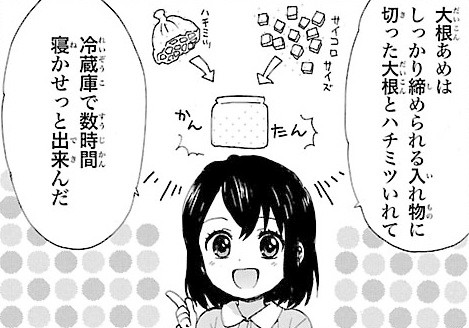
Moka has a sore throat. Hinata scolds her so harshly that Moka cries, then makes up for it with a jar of daikon syrup. Moka tastes it and is surprised that it’s sweet and nothing like daikon.
- 日向:
- 「大根あめはしっかり締められる入れ物に切った大根とハチミツいれて」
- “For daikon syrup, you put cut daikon and honey in a container that seals tight...”
- 「冷蔵庫で数時間寝かせっと出来んだ」
- “...and once you let it sit in the fridge for a few hours, it's ready.”
Key Points
- 寝かせる means “to put to bed”. In cooking it means to leave food alone so time can do the work: dough rests, curry sits overnight, and here daikon steeps in honey.
- The object is often left out. Hinata means the jar of daikon and honey from her first line.
- 寝かせると出来る is “if you let it sit, it’s ready”. The と links a step to the result that always follows it, the way recipes and instructions do.
- 寝かせっと is 寝かせると. Before と, the る shrinks to a small っ.
- 出来んだ is 出来るんだ. The る turns into ん before だ. The んだ explains how the thing works.
- いれて drops the particle を after ハチミツ. Hinata lists the ingredients and moves straight on to the next step.
- 締められる is the potential form of 締める, “to close tight”. しっかり締められる入れ物 is “a container you can seal tight”.
Vocabulary
大根 (Daikon radish)
大根 is a long white radish, eaten simmered, pickled, or grated. 大根役者 is a ham actor.
あめ (Candy)
あめ is hard candy, or a sweet syrup such as starch syrup. In 大根あめ, it is a syrup made by steeping daikon in honey. It is also written 飴.
しっかり (Firmly)
しっかり describes doing something properly and with care, or holding something firmly. It also describes a person who is reliable and sensible.
締める (To tighten)
締める is to tighten or fasten something, such as a lid, a belt, or a necktie. It also means to tighten up on spending or discipline.
入れ物 (Container)
入れ物 is a container, anything you put things in, such as a jar, box, or case.
切る (To cut)
切る is to cut something. It also means to end a phone call or turn something off.
ハチミツ (Honey)
ハチミツ is honey, the sweet syrup bees make from flower nectar. It is also written はちみつ or 蜂蜜.
いれる (To put in)
いれる is to put something inside something else. It also means to make tea or coffee. It is the kana spelling of 入れる.
冷蔵庫 (Refrigerator)
冷蔵庫 is the kitchen appliance that keeps food and drink cold. Its freezer section is the 冷凍庫.
数時間 (Several hours)
数時間 is a few hours, an amount of time somewhat longer than an hour or two.
寝かせる (To let rest)
寝かせる is to put someone to bed or lay something down. In cooking, it means leaving food alone for a while so it can rest, ferment, or age, as with dough or curry.
出来る (To be able to)
出来る means to be able to do something. It can also mean that something is made, completed, or comes into existence.
See Also
- Vocabulary: Collocations for cooking
- Grammar: Natural result with 〜と
- Grammar: How casual contractions work
- Grammar: Reasoning with 〜のだ
- Grammar: Able to do with 〜れる・〜られる
- Grammar: Connecting actions with 〜て・〜で
- Kanji: Entering and putting in with 入
- Kanji: Going out and emerging with 出
- Kanji: Spaces and intervals with 間
- Kanji: Things and kinds with 物
- Kanji: Time and occasions with 時