Limited amusement park admission with 入場制限
Kanji Explanation: Boundaries and limits with 限
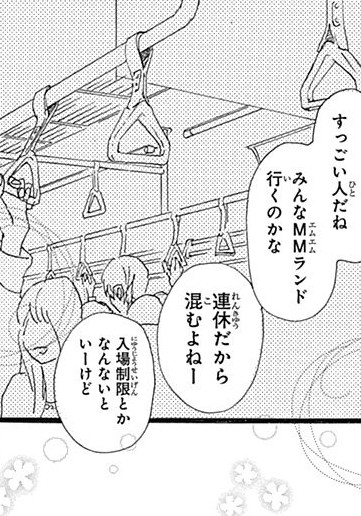
Takeo and his friends board the train bound for the amusement park, MM Land.
- 凛子:
- 「すっごい人だね。みんなMMランド行くのかな」
- “There's a lot of people here. I wonder if everyone's going to MM Land.”
- 隼人:
- 「連休だから混むよねー」
- “It's a long holiday, so it'll be crowded.”
- 愛:
- 「入場制限とかなんないといーけど」
- “I hope they don't restrict admission or anything.”
- Literal: “I hope it doesn't become something like admission restrictions.”
Key Points
1入場制限 = “admission restriction”
- 入場 means “entering” or “admission” (to a venue).
- 制限 means “restriction” or “limit”.
- Together, 入場制限 refers to limiting the number of people allowed to enter, commonly used for crowded venues like amusement parks, concerts, or events.
2Casual contractions: なんない and といー
- なんない is the casual spoken form of ならない (negative of なる “to become”).
- といー is the casual form of といい (“it would be good if / I hope”).
- Full form would be: 入場制限とかならないといいけど.
3とか adds vagueness (“or anything”)
- とか after a noun means “things like” or “or something/anything”.
- Here it shows Ai isn’t just worried about admission restrictions specifically, but that and similar problems.
4Sentence-ending けど softens the statement
- The けど at the end doesn’t mean "but" here; it’s a softening particle that shows concern or leaves the thought open.
- Makes the statement sound less direct and more like casual worry shared with friends.
Vocabulary
行く (To go)
行く means to go or move toward a place away from the speaker.
連休 (Consecutive holidays)
連休 means two or more consecutive days off.
入場制限 (Admission restriction)
入場制限 means an admission restriction or limit on the number of people allowed to enter a venue.
See Also
- Kanji: Boundaries and limits with 限
- Grammar: Hoping with 〜といい
- Grammar: Wondering with かな
- Kanji: Entering and putting in with 入
- Kanji: Linking and succession with 連
俺物語!! © its respective creators. It is used here for educational commentary.