Littering a soft drink can with ポイ捨て
Vocabulary Explanation: Littering with ポイ捨て
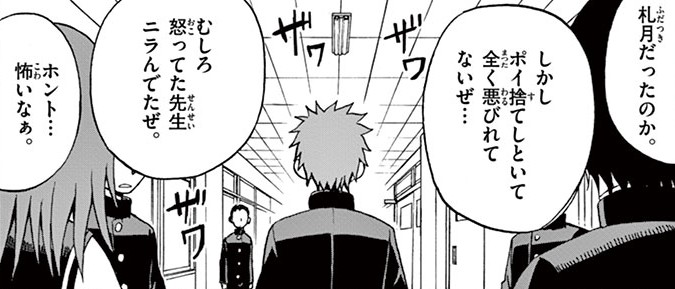
As Kenji Fudazuki ponders ways to increase his image as a delinquent, he hears a teacher asking who littered an empty soft drink can. Seeing an opportunity, Kenji takes credit for the misdeed. With this revelation, the teacher backs off and leaves quietly.
- Students:
- 「札月だったのか。」
- “So it was Fudazuki, huh?”
- 「しかしポイ捨てしといて全く悪びれてないぜ…」
- “But to litter, he really has no shame...”
- 「むしろ怒ってた先生ニラんでたぜ。」
- “Instead, he glared at the scolding teacher.”
- 「ホント…怖いなぁ。」
- “He truly is scary.”
Key Points
- ポイ mimics tossing something lightly; 捨て means discarding.
- Together it means littering.
- ポイ捨てしといて means “after littering” or “having littered”.
- 悪びれる means to act ashamed or guilty.
- 全く悪びれてない says Kenji does not seem sorry at all, which supports his delinquent image.
Vocabulary
| Word | English | Meaning |
|---|---|---|
| ポイ捨て | Littering | ポイ捨て is carelessly tossing trash on the ground. |
| する | To do | する is to do or perform something. It also turns many nouns into verbs, as in 勉強する. |
| 全く | Completely | 全く means “completely”. With a negative, it means “not at all”. Said alone, it shows exasperation: “honestly!” |
| 悪びれる | To act guilty | 悪びれる is to look ashamed. It usually appears as 悪びれない, describing someone who shows no shame. |
| むしろ | Rather | むしろ says one choice fits better than the other: “if anything” or “instead”. |
| 怒る | To get angry | 怒る is to get angry. It also means to scold someone. |
| 先生 | Teacher | 先生 is a respectful title for teachers and certain professionals, including doctors, lawyers, and politicians. Speakers do not normally use it for themselves. |
| にらむ | To glare | にらむ is to look at someone with a hard, angry stare. It also means to suspect someone. It is also written 睨む. |
| ホント | Really | ホント is a casual form of 本当, “truth” or “really”. |
| 怖い | Scary | 怖い describes something that makes you afraid. |
See Also
- Vocabulary: Littering with ポイ捨て
- Grammar: Doing in advance with 〜ておく
- Grammar: Past tense with 〜た・〜だ
- Grammar: The copula だ
- Grammar: Compound voicing with 連濁
- Grammar: How casual contractions work
- Grammar: Rough declarations with ぞ and ぜ
- Kanji: Wholeness and completion with 全