Looking after a drunk sister with 看る
Vocabulary Explanation: Ways of seeing with みる
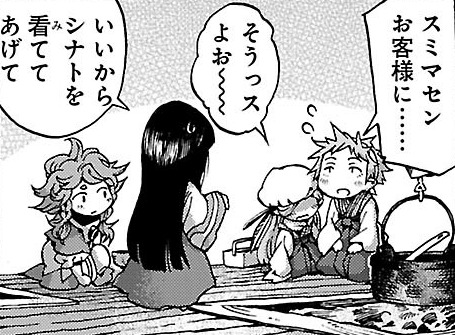
A blizzard has stranded Hakumei and Mikochi at the shop Shinato runs with her younger brother Mimari. Over drinks, the four play a betting game with chopsticks, and Hakumei keeps pouring for Shinato, who can’t hold her liquor, to throw off her game. With Shinato now very drunk, Mikochi offers to bring the big pot of dumpling soup over and asks Hakumei to help.
- ミマリ:
- 「スミマセン お客様に……」
- “Sorry, making our guests...”
- シナト:
- 「そうっスよお~~~」
- “Yeahhh, that's riiight~”
- ミコチ:
- 「いいからシナトを看ててあげて」
- “Never mind that. You look after Shinato.”
Key Points
- 看る is looking after someone who is sick or can’t look after themselves. It uses the 看 of 看病, “nursing”, and 看護師, “nurse”.
- Shinato is too drunk to manage on her own, so Mikochi gives Mimari the job of minding her.
- 見る is also correct for this sense. 看る narrows it to caring for someone.
- 看てて is the casual contraction of 看ていて. The ている part makes it ongoing: keep looking after her.
- 〜てあげる frames the care as something Mimari does for Shinato. The final て turns the whole phrase into a casual request.
- いいから means “it’s fine, so…”. Mikochi brushes off Mimari’s apology and moves straight to what she wants him to do.
- Mimari’s お客様に…… trails off. He means something like お客様にそんなことをさせて, “making guests do that”.
- Shinato echoes him in his own っス style, slurring the end.
Vocabulary
| Word | English | Meaning |
|---|---|---|
| すみません | Excuse me | すみません is a polite “excuse me” or “I’m sorry”. People also use it to get someone’s attention, as when calling over a shop clerk, and sometimes to say thank you. |
| お客様 | Customer | お客様 is a very polite word for a customer or guest, used by staff in shops and restaurants. |
| そう | So | そう means “like that” or “that way”. Said alone, it agrees: “right”. After a verb stem or adjective, it means something looks or seems a certain way. |
| 看る | To look after | 看る is to look after someone who is sick or can’t take care of themselves, such as sitting with a patient. |
| あげる | To give | あげる is to give something to someone else. After a て-form verb, it means doing something for someone. It also means to raise something. |
See Also
- Vocabulary: Ways of seeing with みる
- Vocabulary: Don't worry about it with いいから
- Grammar: Doing for someone with 〜てあげる
- Grammar: How casual contractions work
- Grammar: Requests with 〜てください and 〜てくれ
- Kanji: Forms and appearances with 様