Looking grown-up with hair tied back with 〜っぽい
Grammar Explanation: Kind of like with 〜っぽい
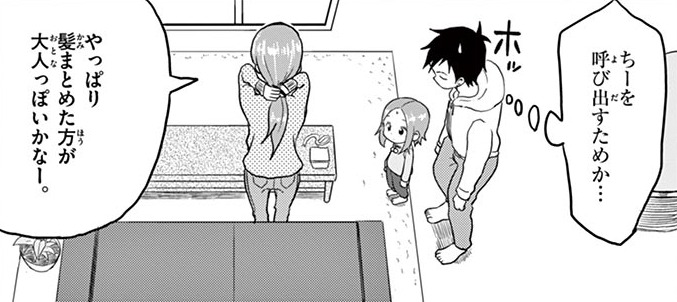
Chii has run off with Takagi’s hair tie. On Christmas Eve, Takagi calls out that a scatterbrained Santa left a present behind. When Chii opens the box, a knitted bear springs out at her. Takagi wonders aloud whether Santa found out about the hair tie, and Chii hands it back.
- 西片:
- 「ちーを呼び出すためか…」
- “So it was to get Chii to come out...”
- 高木:
- 「やっぱり髪まとめた方が大人っぽいかなー。」
- “I guess I do look more grown-up with my hair tied back, huh?”
Key Points
- っぽい after the noun 大人, “adult”, makes an い-adjective meaning “grown-up” or “mature-looking”. It describes the feel of something, not what it actually is.
- Takagi is already an adult, so she isn’t asking whether she’s grown up. She’s asking whether the hairstyle gives her a more mature look.
- 大人っぽい is usually a compliment. Its opposite, 子供っぽい, usually isn’t.
- As an い-adjective, 大人っぽい goes straight before かな with no だ.
- 方が marks the side that comes out ahead in a comparison. The other side is the way she has worn her hair since Chii took the hair tie: down. It goes unsaid because everyone can see it.
- The た-form まとめた doesn’t mean the tying is finished. It pictures one situation, “if my hair is tied back”.
- The object particle を after 髪 is dropped, as it often is in casual speech.
- やっぱり means “after all” or “as I thought”. It presents the idea as something Takagi already had in mind.
- かな is “I wonder”, and the stretched かなー sounds drawn out and thoughtful. She’s talking to herself, but Nishikata is standing right there to hear it.
- 呼び出す is “to call someone out” or “summon”. ため gives the purpose, so ちーを呼び出すため is “to get Chii to come out”.
- か here is a realization, “so that’s it”. Nishikata works out that the Santa present was bait to bring Chii out with the hair tie, and he relaxes once he sees it.
Vocabulary
呼び出す (To call out)
呼び出す is to call someone and get them to come out or come to a certain place, such as summoning someone to an office or paging them.
ため (For)
ため is the purpose or benefit of something: 〜のため means “for the sake of” or “in order to”. It can also give a cause: “because of”. It is also written 為.
やっぱり (As expected)
やっぱり shows that something turned out as the speaker thought, or that the speaker is coming back to an earlier choice: “after all”.
髪 (Hair)
髪 is the hair on a person’s head.
まとめる (To gather together)
まとめる is to gather separate things into one, such as collecting papers, summing up an idea, or settling a plan. With 髪, it means to tie back or put up your hair.
方 (Side)
方 is a direction or side. In comparisons, 〜方がいい means “it’s better to”. Read かた, it is a polite word for a person.
大人っぽい (Grown-up)
大人っぽい describes someone or something that looks or acts mature, like an adult. It’s usually a compliment, as when a teenager or a hairstyle seems more grown-up.
っぽい (-ish)
っぽい follows a word to say something seems like it or tends toward it.
See Also
- Grammar: Kind of like with 〜っぽい
- Grammar: More than with 〜方が and 〜より
- Grammar: Wondering with かな
- Grammar: Purpose and cause with 〜ために
- Kanji: Going out and emerging with 出
- Kanji: People and persons with 人