Losing all that built-up friendship with 水の泡になる
Idiom Explanation: All that effort for nothing with 水の泡になる
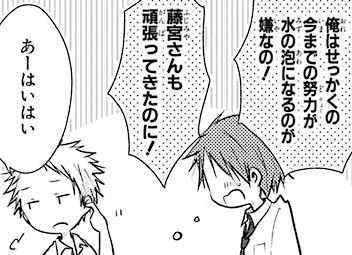
Although Fujimiya loses her memory of friends every Monday morning, she and Hase have become close enough that she feels comfortable around him when meeting him “for the first time” at school each Monday. Hase fears that progress will be lost during summer break.
- 長谷:
- 「俺はせっかくの今までの努力が水の泡になるのが嫌なの!」
- “I hate seeing all my hard work up to now go down the drain!”
- Literal: “I hate my hard work up to now becoming bubbles of water!”
- 「藤宮さんも頑張ってきたのに!」
- “Fujimiya-san has worked so hard, too!”
- 桐生:
- 「あーはいはい」
- “Yeah, got it.”
Key Points
1The idiom 水の泡になる
- Literal meaning: “become bubbles on water” (bubbles vanish quickly, leaving nothing).
- Common English equivalents: “go down the drain”, “be wasted”, “all for nothing”, “come to nothing”.
- Basic pattern: Ⓐが 水の泡になる “Ⓐ ends up completely wasted / for nothing”.
2せっかく + の + noun
- Emphasizes that the noun was obtained “with great effort”, “after so much trouble”.
- Often carries the nuance: “It would be a shame if this were lost”.
- Typical feeling: disappointment when hard-earned progress is threatened.
3~のが嫌だ / 嫌なの
- Pattern [clause] のが嫌だ “I hate it when [clause] happens”, “I hate the fact that…”
- Expresses dislike for an entire situation rather than a single object.
- 嫌なの (explanatory のだ-form) is a softer, more emotional/justifying tone common in speech (“That’s why I hate it…”)
4Double が construction
- The sentence has two grammatical subjects at different levels.
- First が marks the subject inside the embedded clause (努力が 水の泡になる).
- Second が marks the whole long clause as the subject of 嫌だ (【clause】が 嫌なの).
5Multiple の usages in one sentence
- せっかくの is an adjectival (“hard-earned”).
- 今までの is a temporal modifier (“up until now” modifies 努力).
- 水の marks possession (“bubbles of water”).
- …になるの is a nominalizer (turns verb phrase into noun).
- 嫌なの is the explanatory のだ (giving reason/emotional tone).
6Embedded clause structure
- Core: 努力が 水の泡になる (“effort goes to waste”).
- Full layered version: せっかくの 今までの 努力が 水の泡になる.
- The entire phrase is then nominalized with の to serve as the subject of 嫌なの.
7Second sentence: 藤宮さんも頑張ってきたのに!
- も “too”, “also”.
- inclusive “not just me, but Fujimiya as well”.
- 頑張って + きた “has been working hard (continuously up to now)”.
- 〜のに “even though”, “despite the fact that…” conveys regret, frustration, or sense of unfairness.
- さん is an honorific suffix attached to a person’s name to show respect and social distance, roughly equivalent to “Mr.”, “Ms.”, or “Mrs.” in English, though it’s used far more broadly and doesn’t specify gender or marital status.
Vocabulary
俺 (I)
俺 means “I” or “me”. Men commonly use it in casual speech, and it sounds rougher and more masculine than 私 or 僕.
せっかく (With much effort)
せっかく marks an effort or valuable opportunity that should not go to waste. Depending on the sentence, it can mean “after taking the trouble” or “since we have the chance”.
努力 (Effort)
努力 means sustained effort or hard work toward a goal.
See Also
- Idiom: All that effort for nothing with 水の泡になる
- Future entry: Past tense with 〜た・〜だ
- Grammar: Wasted effort with せっかく〜のに
- Grammar: Reasoning with 〜のだ
- Grammar: Marking the topic with は and も
一週間フレンズ。 © its respective creators. It is used here for educational commentary.