Low heat for Komari's curry with 弱火
Vocabulary Explanation: Collocations for cooking
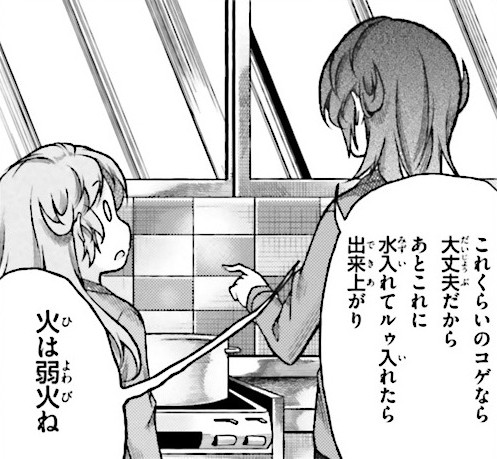
Komari insisted on making dinner by herself to prove to her sister Natsumi that she can cook. She settled on curry, using last night’s leftover meat and potato stew as the base, but while she was searching the kitchen for sugar, the pot began to smoke. Her mother came in, turned off the burner, and told her a little smoke was nothing to panic over.
- お母さん:
- 「これくらいのコゲなら大丈夫だから あとこれに水入れてルゥ入れたら出来上がり」
- “This little bit of scorching is fine. Now just add water and the roux, and it's done.”
- Literal: “If it's scorching of about this much, it's fine, so after that, once you put water in this and put roux in, it's finished.”
- 「火は弱火ね」
- “Keep it on low heat, okay?”
- Literal: “As for the flame, low heat, okay?”
Key Points
- Recipes give heat in words built on 火, the burner’s flame: 強火 high, 中火 medium, 弱火 low, and とろ火 very low. After another word, 火 is read び.
- 弱 means weak, so 弱火 is a weak flame. Recipes use it for simmering and for anything that scorches easily.
- The heat levels take で for how you cook something, as in 弱火で煮る, “simmer over low heat”, and に for changing the setting, as in 弱火にする, “turn it down to low”.
- は makes 火 the topic: “as for the flame”. Her mother has gone through the remaining steps, and now she turns to the heat.
- The verb is left out. Spelled out, the line would be 火は弱火にしてね, “set the flame to low, okay?” Short instructions like this often stop at the noun.
- ね asks Komari to go along with it. It softens the instruction into a reminder.
- くらい marks a rough amount. これくらいの means “about this much”, here a small amount.
- なら after a noun means “if it’s”: if it’s only this much scorching, the curry is still fine. だから gives that as the reason to carry on.
- コゲ is 焦げ, “scorching” or “burnt part”, written in katakana.
- あと here means “all that’s left”. The steps that follow are the rest of the job.
- In casual speech the を after 水 and ルゥ drops out. The full form is 水を入れて、ルゥを入れたら.
- 〜たら means “once”: once the roux is in, the curry is 出来上がり, “finished”. 出来上がり is a noun, so it can end the sentence alone.
Vocabulary
これ (This)
これ points to something close to the speaker, or to the thing just mentioned.
くらい (About)
くらい after a number or amount means “about” or “around”. With は, as in 一人くらいは, it means “at least”. It is also pronounced ぐらい.
コゲ (Scorching)
コゲ, usually written 焦げ, is the burnt or scorched part of food, such as rice or curry stuck to the bottom of a pot.
大丈夫 (All right)
大丈夫 describes being all right, with nothing to worry about. People use it to reassure others, or to politely say “no thanks”.
あと (After)
あと is the time after something, the space behind something, or what remains. At the start of a sentence, it adds one more point, like “also”. It is also written 後.
水 (Water)
水 is water, especially cold water.
入れる (To put in)
入れる is to put something inside something else. It also means to let someone in, or to make tea or coffee.
ルゥ (Roux)
ルゥ is roux, and in Japan especially the solid blocks of curry or stew base that melt into a pot to thicken and season it. It is also written ルー or ルウ.
出来上がり (Finished)
出来上がり is the point when something is finished, or the finished result. Said alone, as in “出来上がり!”, it announces that food or work is done.
火 (Fire)
火 is fire or flame. In cooking, it also means the heat of a stove, as in 火を通す, “to cook something through”.
弱火 (Low heat)
弱火 is a low flame on a stove, the weakest of the usual heat settings in cooking. It is used for simmering and for food that scorches easily.
See Also
- Vocabulary: Collocations for cooking
- Grammar: Seeking agreement with ね
- Grammar: Marking the topic with は and も
- Grammar: If that's the case with なら
- Grammar: If and when with 〜たら
- Grammar: Because with 〜から
- Kanji: Entering and putting in with 入
- Kanji: Going out and emerging with 出