Lunch duty today of all days with 〜に限って
Grammar Explanation: Of all times to happen with 〜に限って
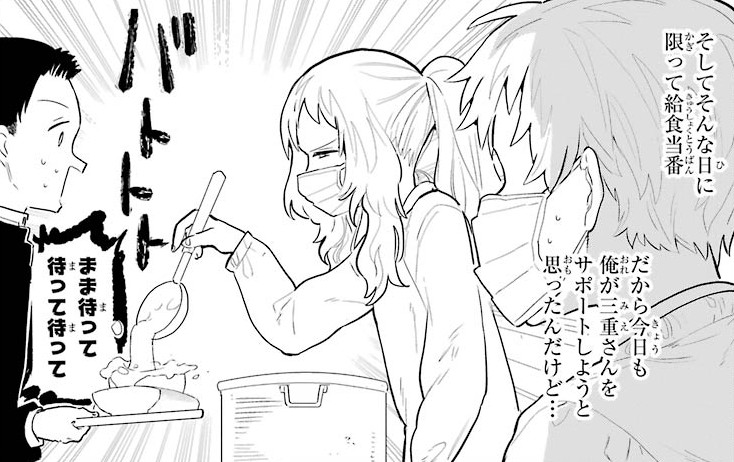
Komura and Mie have serving duty in the cafeteria. Normally this wouldn’t be an issue, except today Mie accidentally stepped on her glasses and broke them, and can barely see without them.
- 小村:
- 「そしてそんな日に限って給食当番」
- “Thus, on a day such as that (of all days), she has lunch duty.”
- Literal: “And on such a day of all days, lunch duty.”
- 「だから今日も俺が三重さんをサポートしようと思ったんだけど…」
- “Therefore, I thought I'd support Mie today as well, but...”
- Literal: “So today too I thought I would support Mie-san, but...”
- 男の子:
- 「まま待って待って待って」
- “W-w-wait, wait, wait!”
- Literal: “W-w-wait, wait, wait!”
Key Points
- 〜に限って marks a time or situation as especially inconvenient or ironic.
- Komura means lunch duty happens precisely on the day Mie can barely see.
- さん is an honorific suffix attached to a person’s name to show respect and social distance, roughly equivalent to “Mr.”, “Ms.”, or “Mrs.” in English, though it’s used far more broadly and doesn’t specify gender or marital status.
Vocabulary
| Word | English | Meaning |
|---|---|---|
| そんな | Like that | そんな describes something like the thing just mentioned. Said alone, it shows shock or denial: “no way!” |
| 日 | Day | 日 is a day. It also means the sun or sunlight. |
| 給食当番 | Lunch duty | 給食当番 is the job of serving school lunch to classmates, done in turns. |
| 今日 | Today | 今日 means today. In formal writing, it can also mean the present day or current era. |
| 俺 | I | 俺 means “I” or “me”. Men commonly use it in casual speech, and it sounds rougher and more masculine than 私 or 僕. |
| サポート | Support | サポート is helping or backing someone up. |
| 思う | Think | 思う is to have a thought, feeling, belief, or hope about something. |
| 待つ | To wait | 待つ is to stay until someone comes or something happens. |
See Also
- Grammar: Of all times to happen with 〜に限って
- Grammar: Past tense with 〜た・〜だ
- Grammar: Marking the subject with が
- Grammar: Marking the topic with は and も
- Grammar: Quoting and reporting with と and って
- Grammar: Connecting actions with 〜て・〜で
- Grammar: Volitional with 〜う・〜よう
- Grammar: But with 〜けど and 〜けれど
- Kanji: Eating and food with 食
- Kanji: Matching and appropriateness with 当
- Kanji: Now and the present with 今