Made to quit smoking with 〜させられる
Grammar Explanation: Being made to do with 〜させられる
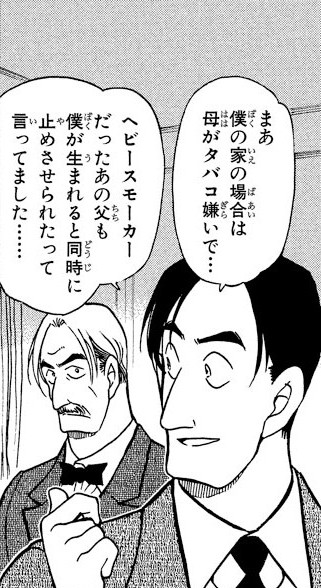
Four actors filming a mystery drama at a mansion are suspects in a real murder. While they wait with Kogoro, he lights a cigarette, and the actress Ruri says her father’s dislike of smoking rubbed off on her. Nobuharu, who acts alongside his father, Akatsuki, says it’s the same in his family.
- 伸晴:
- 「まあ 僕の家の場合は母がタバコ嫌いで…」
- “Well, in my family's case, it's my mother who hates cigarettes...”
- 「ヘビースモーカーだったあの父も僕が生まれると同時に止めさせられたって言ってました……」
- “Even my dad there, who used to be a heavy smoker, told me she made him quit the moment I was born...”
- Literal: “Even that father, who was a heavy smoker, said he was made to quit at the same time I was born...”
Key Points
- 止める is an ichidan verb, so it takes させられる: 止めさせる, “make someone quit”, becomes 止めさせられる, “be made to quit”.
- The subject is あの父. The person who made him quit isn’t marked with に here, but the first line already named her. It was the mother who hates cigarettes.
- The heavy smoker didn’t want to stop, which is just the reluctance させられる carries.
- って quotes what the father said. 言ってました is the polite past of 言っている, so Nobuharu is passing along something his father has told him, maybe more than once.
- 僕が生まれると同時に is “at the same time as I was born”. The dictionary form 生まれる comes before と同時に, even though the birth was in the past.
- あの points to someone both speakers can see. Nobuharu’s father is standing right behind him, so あの父 is “my dad there” or “even that dad of mine”.
- も makes it “even”: even a heavy smoker like him had to quit.
Vocabulary
まあ (Well)
まあ is a soft “well” that eases into what the speaker says, or accepts something half-heartedly. It also shows mild surprise, like “oh my”.
僕 (I)
僕 means “I” or “me”. Boys and men commonly use it in casual speech, and it sounds softer than 俺.
家 (House)
家 is a building where people live.
場合 (Case)
場合 means a case, situation, or set of circumstances. It often follows a condition to mean “if” or “in the case of”.
母 (Mother)
母 is one’s own mother, the word used when speaking of her to others.
タバコ (Cigarettes)
タバコ is tobacco or cigarettes. It is also written 煙草.
嫌い (Disliked)
嫌い describes something a person dislikes or hates. After a noun, as in タバコ嫌い, it is read ぎらい and describes someone who can’t stand that thing.
ヘビースモーカー (Heavy smoker)
ヘビースモーカー, from English “heavy smoker”, is someone who smokes a lot.
あの (That)
あの comes before a noun to mean “that” or “those”. It points to someone or something away from both speakers, or something they both know about.
父 (Father)
父 is one’s own father, the word used when speaking of him to others.
生まれる (To be born)
生まれる is to be born. It can also mean for something new to come into being.
止める (To stop)
止める is to stop something moving or happening. Read やめる, it means to quit doing something.
させる (To make someone do)
させる is the causative form of する. It means to make someone do something or to let them do it.
言う (To say)
言う means to say or tell. It can also mean to call something by a particular name.
See Also
- Grammar: Being made to do with 〜させられる
- Grammar: Quoting and reporting with と and って
- Kanji: Homes and specialists with 家
- Kanji: Joining and fitting with 合
- Kanji: Time and occasions with 時