Made to run around with 〜される
Grammar Explanation: Being made to do with 〜させられる
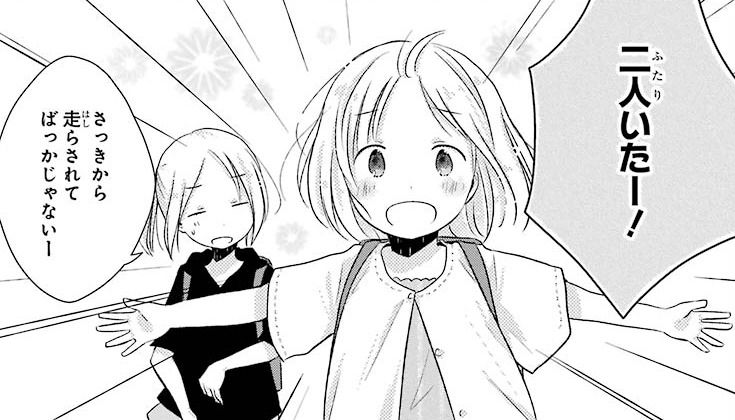
Kakihara remembers a day from her childhood. She stopped to look at some hydrangeas, and while she wasn’t paying attention, Sana challenged everyone to a race to the park and the others ran off. Only Shun stayed behind to wait for her.
- 紗奈:
- 「二人いたー!」
- “There you two are!”
- 千尋:
- 「さっきから走らされてばっかじゃないー」
- “All we've done is get dragged into running!”
- Literal: “Since a while ago, isn't it nothing but being made to run?”
Key Points
1走らされる, “be made to run”
- 走る is a godan verb. Its causative-receptive is usually the short form 走らされる, “be made to run”, rather than 走らせられる.
- Chihiro doesn’t name who made her run. Sana is standing right there, and her race is the reason they’ve been running.
2〜てばっか, “nothing but”
- ばっか is a casual form of ばかり. After a て-form, 〜てばかり says someone keeps doing one thing and nothing else.
- さっきから走らされてばっか is “I’ve been made to do nothing but run for a while now”.
3じゃないー as a complaint
- じゃない with a falling, drawn-out tone isn’t a negative here. It points out something the speaker thinks the listener should see: “come on, all we’ve done is run!”
4二人いたー!
- いた is the past of いる, but here it means “found them”. Japanese uses the past tense when you discover something: 二人いた is “there you two are”.
Vocabulary
二人 (Two people)
二人 means two people.
いる (To be)
いる is to exist or be somewhere, for people and animals. After a て-form verb, it shows an ongoing action or a continuing state.
さっき (A moment ago)
さっき is a short time before now.
走る (To run)
走る is to run.
ばかり (Only)
ばかり means “only” or “nothing but”. After a て-form, it says someone keeps doing one thing. After a number, it means “about”. Casual speech shortens it to ばっかり or ばっか.
See Also
- Grammar: Being made to do with 〜させられる
- Grammar: Nothing but with 〜ばかり
- Grammar: Past tense with 〜た・〜だ
- Kanji: People and persons with 人
僕が僕であるために。 © its respective creators. It is used here for educational commentary.