Made to wear a panda costume with 〜させられる
Grammar Explanation: Being made to do with 〜させられる
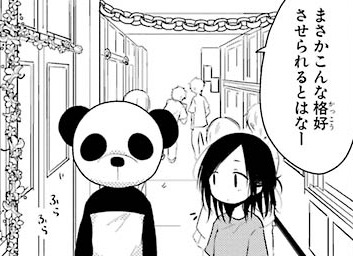
At the school festival, Hase, Kiryuu, and Fujimiya are put in charge of drawing customers to their class’s café. The class wants one of them in costume. Kiryuu gets a sharp waiter’s outfit, and Hase ends up inside a panda suit.
- 長谷:
- 「まさかこんな格好させられるとはなー」
- “Never thought they'd make me wear something like this.”
- Literal: “I never imagined I'd be made to dress like this.”
Key Points
1格好(を)させられる, “be made to dress like that”
- 格好をする means “dress like” or “wear an outfit like”. Its causative 格好をさせる is “make someone dress like that”, and させられる turns it around: “be made to dress like that”.
- Hase drops the を after 格好, as people often do in casual speech.
- Nobody is named as the one who made him do it. It’s his class, which handed him the costume.
2まさか〜とは, “never would have thought”
- まさか expects something unlikely, and とは at the end of the clause marks it as the thing that’s hard to believe. Together they mean “I never imagined that…”.
- A verb like 思わなかった is left unsaid after とは. The full thought is “I never thought I’d be made to wear this”.
3Drawn-out なー
- な is a casual sentence ending used when talking half to yourself. Stretched out as なー, it makes Hase’s line sound like a weary sigh.
Vocabulary
まさか (Surely not)
まさか marks something as hard to believe or unexpected, like “no way” or “surely not”. With a clause ending in とは, it means “I never thought that…”.
こんな (Like this)
こんな describes something like the thing in front of the speaker or the thing just mentioned.
格好 (Appearance)
格好 is the way someone looks or is dressed. 格好をする means to dress a certain way. It can also mean posture, or something being suitable.
させる (To make someone do)
させる is the causative form of する. It means to make someone do something or to let them do it.
See Also
- Grammar: Being made to do with 〜させられる
一週間フレンズ。 © its respective creators. It is used here for educational commentary.