Making a point of trying horror movies with 〜ようにしている
Grammar Explanation: Making an effort to with 〜ようにする
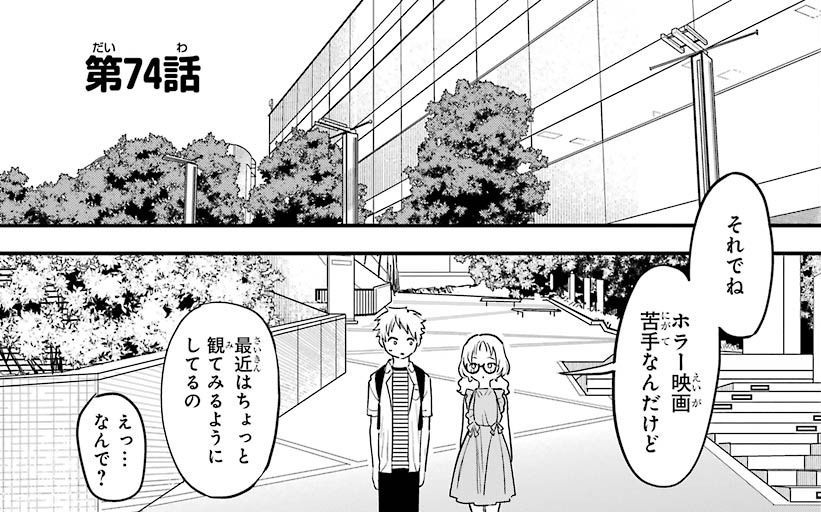
Komura and Mie have spent the day at the aquarium. Now the two of them are walking together outside.
- 三重:
- 「それでね」
- “So, um...”
- 「ホラー映画苦手なんだけど」
- “I'm no good with horror movies, but...”
- 「最近はちょっと観てみるようにしてるの」
- “...lately I've been making a point of trying to watch them a little.”
- 小村:
- 「えっ…なんで?」
- “Huh...? Why?”
Key Points
- 〜ようにしている describes something someone takes care to do as a regular practice. Mie isn’t talking about one movie. Lately, she has been making a habit of it.
- ようにする puts effort behind the action. Horror isn’t something she’d watch for fun, so the watching takes a deliberate choice.
- ちょっと keeps the effort modest: she watches a little, not whole marathons.
- 〜てみる means doing something to see how it goes. With 観てみる, Mie is testing herself by watching a bit, without promising to like it.
- 観る is a spelling of みる used for watching films, shows, and performances. 見る is the general spelling for seeing or looking.
- してる is the casual contraction of している. The い drops out in speech.
- The sentence-final の presents the statement as an explanation. It sounds soft and conversational, and it sets up her reason, which Komura asks for next.
- 苦手 means being bad at something or not liking it. Here it’s horror movies she can’t handle. The particle が after 映画 is dropped, as often happens in casual speech.
- なんだけど gives background before the main point. な joins the な-adjective 苦手 to んだ, and けど leads into the contrasting news.
- それでね picks the conversation back up. それで is “and so” or “then”, and ね keeps Komura’s attention.
Vocabulary
ホラー (Horror)
ホラー is the horror genre, stories in films, books, or games meant to frighten, often with ghosts or monsters. It usually comes before a noun, as in ホラー映画, “horror movie”.
映画 (Film)
映画 is a movie, a story told in moving pictures shown on a screen.
苦手 (Weak point)
苦手 means something one is bad at or someone one finds difficult to deal with.
ちょっと (A little)
ちょっと describes a small amount or a short time. It also softens a refusal, or calls someone’s attention, like “hey”.
観る (To watch)
観る is to watch something with attention, such as a movie, show, or game. It is a narrower spelling of 見る.
みる (To see)
みる is the kana spelling of 見る, “to see”. After a て-form verb, it means to try doing something to see how it goes.
よう (Way)
よう follows a word to show a way or manner, or that something seems a certain way. ようになる means to reach a point where something happens. It is also written 様.
する (To do)
する is to do or perform something. It also turns many nouns into verbs, as in 勉強する.
なんで (Why)
なんで asks for the reason something happens. It is more casual than どうして.
See Also
- Grammar: Making an effort to with 〜ようにする
- Grammar: Trying it out with 〜てみる
- Grammar: How casual contractions work
- Grammar: Reasoning with 〜のだ
- Kanji: Hands and skill with 手
- Kanji: Pictures and plans with 画