Making it so you can walk on water with 〜ようにする
Grammar Explanation: Making an effort to with 〜ようにする
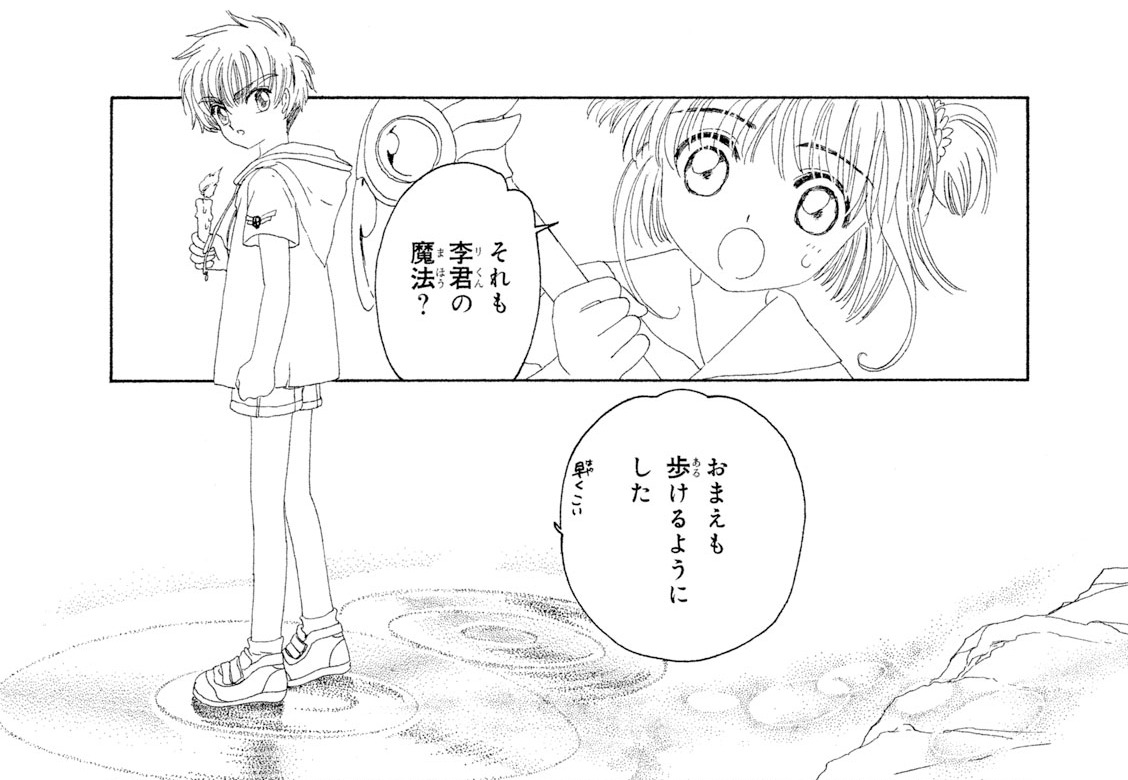
During a test of courage in a cave, Sakura’s classmates vanish one by one. Li senses a Clow Card near the shrine by the spring at the end of the cave, and he lights a candle with fire magic so they can see. The bridge across the water to the shrine has burned. Sakura suggests flying over with the Fly card, but Li says they should approach quietly so the card won’t notice them. He chants a spell, and sparkles swirl around both their feet. Then Li steps out onto the water, and Sakura cries out his name.
- 桜:
- 「それも李君の魔法?」
- “Is that your magic too, Li?”
- 小狼:
- 「おまえも歩けるようにした」
- 「早くこい」
- “I made it so you can walk on it too.”
- “Hurry up and come on.”
Key Points
- 歩ける is the potential form of 歩く, “to walk”. 〜ようにする after it means setting things up so that something becomes possible.
- Li is the one who did the arranging, with his spell. Sakura is the one who can now walk. ようにする often joins two different subjects this way.
- This isn’t an order. Li hasn’t made Sakura walk, which would be the causative 歩かせる. He made walking possible, then tells her to come.
- Li never says “on the water”. Both of them can see what he’s standing on, so the English adds “on it”.
- も adds Sakura to someone already in the picture. Li is standing on the water, and the spell covers her as well.
- おまえ is a blunt, casual word for “you”. It fits Li’s gruff way of talking to Sakura.
- Sakura has already watched Li light a candle with fire magic. それも asks whether walking on water is another of his spells.
- Sakura calls him by his family name with 君, the way classmates often address boys at school.
- The question has no か. In casual speech, rising intonation alone makes a question.
- こい is the plain imperative of 来る, “to come”. 早く means “quickly”.
- The words are written small beside Li’s speech balloon, so he says them as an aside. He’s impatient to get moving.
Vocabulary
それ (That)
それ points to something near the listener, or to something just mentioned.
君 (You)
君 is a word for “you” used toward equals or people younger or of lower standing. It sounds gentle or poetic. Read くん, it is a suffix on names.
魔法 (Magic)
魔法 means magic, sorcery, or a magical spell.
おまえ (You)
おまえ is a casual, rough word for “you”. Men often use it toward people of equal or lower standing. It is also written お前.
歩く (To walk)
歩く is to move on foot.
よう (Way)
よう follows a word to show a way or manner, or that something seems a certain way. ようになる means to reach a point where something happens. It is also written 様.
する (To do)
する is to do or perform something. It also turns many nouns into verbs, as in 勉強する.
早く (Quickly)
早く means early, soon, or quickly. Said alone, it means “hurry!”
来る (To come)
来る means to come or move toward the speaker or the place being discussed.
See Also
- Grammar: Making an effort to with 〜ようにする
- Grammar: Able to do with 〜れる・〜られる
- Grammar: Marking the topic with は and も
- Grammar: The plain imperative