Making the wrong choice with 選択
Kanji Explanation: Choosing and selection with 選
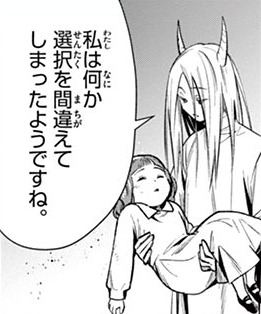
Years ago, Himmel spared a demon child who had eaten a villager’s daughter, and the village chief took the demon in. Now the demon has killed the chief. She tells the grieving mother that she sensed her murderous intent every day and wants to live in peace, so she has brought a replacement for the daughter she ate. The girl in her arms is the chief’s own daughter.
- 魔族:
- 「私は何か選択を間違えてしまったようですね。」
- “It seems I've made the wrong choice somewhere.”
Key Points
- 選択 means a choice or the act of choosing from several options. 選択を間違える is to make the wrong choice.
- The demon talks about the chief’s murder and the “replacement” daughter as a choice, as if she picked the wrong item off a menu. The polite, detached word makes the scene chilling.
- 何か means “something”. 何か選択を means “some choice”. She can’t tell which step went wrong.
- 間違えてしまった marks the mistake as already done and unwanted. Coming from her, it sounds less like remorse than like noticing a plan has failed.
- ようです means “it seems”, based on evidence. Here the evidence is the villagers’ horror.
- ね presents the conclusion as something her listeners can see too.
Vocabulary
| Word | English | Meaning |
|---|---|---|
| 私 | I | 私 means “I” or “me”. It is the standard first-person pronoun in polite speech and is also common in casual speech among women. |
| 何か | Something | 何か means something or anything. It can also introduce an uncertain question, as in “Is something wrong?” |
| 選択 | Selection | 選択 is picking one out of several, or the pick made. A 選択肢 is an option, and 選択科目 is an elective class. |
| 間違える | To make a mistake | 間違える is to get something wrong, or to mistake one thing for another. |