Megure wants his apple peeled with 皮をむく
Vocabulary Explanation: Collocations for cooking
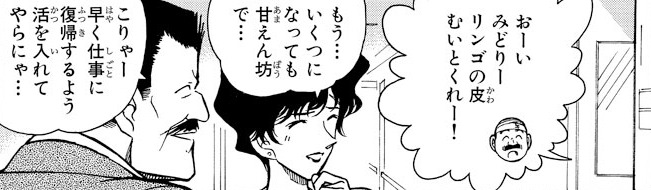
Inspector Megure is in the hospital after an old head wound reopened during a case. Superintendent Matsumoto has just told Kogoro and the others how Megure got the scar twenty years ago. Now Megure’s wife, Midori, has stepped out of his room to greet the visitors.
- 目暮:
- 「おーい みどりー リンゴの皮むいとくれー!」
- “Heeey, Midori! Peel an apple for me!”
- みどり:
- 「もう… いくつになっても甘えん坊で…」
- “Honestly... He's such a baby, no matter how old he gets...”
- 松本:
- 「こりゃー早く仕事に復帰するよう活を入れてやらにゃ…」
- “Looks like I'll have to light a fire under him so he gets back to work soon...”
Key Points
- むく means to strip off an outer layer, and 皮をむく is how you say you’re peeling fruit or vegetables. The kanji is 剥く, but むく is usually written in kana.
- Megure drops を, as people often do in casual speech: リンゴの皮むいて. You can also make the fruit itself the object, as in リンゴをむく.
- おくれ is an older, softer form of くれ, the command form of くれる. 〜ておくれ asks someone to do something for you, and it sounds folksy or old-fashioned.
- In fast speech, て + お contracts to と, so むいておくれ becomes むいとくれ. The stretched くれー! is Megure calling out from the bed.
- いくつ asks a number, here a person’s age. A question word with 〜ても covers every answer, so いくつになっても is “no matter what age he reaches”.
- 甘えん坊 is someone who likes to be pampered. Midori’s もう… is fond exasperation, not real annoyance.
- 活を入れる means to rouse someone or give them a jolt of energy. 〜てやる says Matsumoto will do it to his subordinate.
- 仕事に復帰するよう is ように with に dropped: “so that he returns to work”. Matsumoto acts, but it’s Megure who has to come back.
- やらにゃ is a rough contraction of やらねば, “I must do”. Matsumoto leaves off ならん, the way speakers often stop after なければ.
- こりゃー is これは contracted. It sets up his conclusion: “this calls for…”
Vocabulary
リンゴ (Apple)
リンゴ is an apple. It is also written りんご, or 林檎 in kanji.
皮 (Skin)
皮 is the outer covering of something: the skin or peel of fruit and vegetables, an animal’s hide, or the bark of a tree.
むく (To peel)
むく is to strip off an outer layer, such as the skin of fruit or vegetables. 皮をむく is “to peel”. It is written 剥く in kanji, but kana is more common.
くれる (To give)
くれる is for someone to give something to the speaker or the speaker’s side. After a て-form verb, it means someone does something for the speaker.
いくつ (How many)
いくつ asks how many of something there are. It also asks a person’s age, as in おいくつですか, “how old are you?”
なる (To become)
なる is to change into a different state or become something. It also means something turns out a certain way. It is also written 成る.
甘えん坊 (Spoiled child)
甘えん坊 is someone who wants to be pampered and leans on others, usually a child. An adult gets called one for acting clingy or babyish.
早く (Quickly)
早く means early, soon, or quickly. Said alone, it means “hurry!”
仕事 (Work)
仕事 is work done for a living, or a particular task one has to do.
復帰 (Return)
復帰 is coming back to a job, team, or stage after time away for injury, illness, or leave.
活を入れる (To fire someone up)
活を入れる is to rouse someone who is slacking or give them a jolt of energy. It first meant reviving someone who had fainted, as in judo.
やる (To do)
やる is a casual word for “to do”. It also means to give something to someone of lower standing, or to animals and plants.
See Also
- Vocabulary: Collocations for cooking
- Grammar: Requests with 〜てください and 〜てくれ
- Grammar: How casual contractions work
- Grammar: Even if with 〜ても
- Grammar: Doing for a reason with 〜ように
- Grammar: Must do with 〜なければならない
- Kanji: Entering and putting in with 入
- Kanji: Living and lively movement with 活
- Kanji: Matters and events with 事