Merely by shaking hands with 握手
Kanji Explanation: Gripping and control with 握
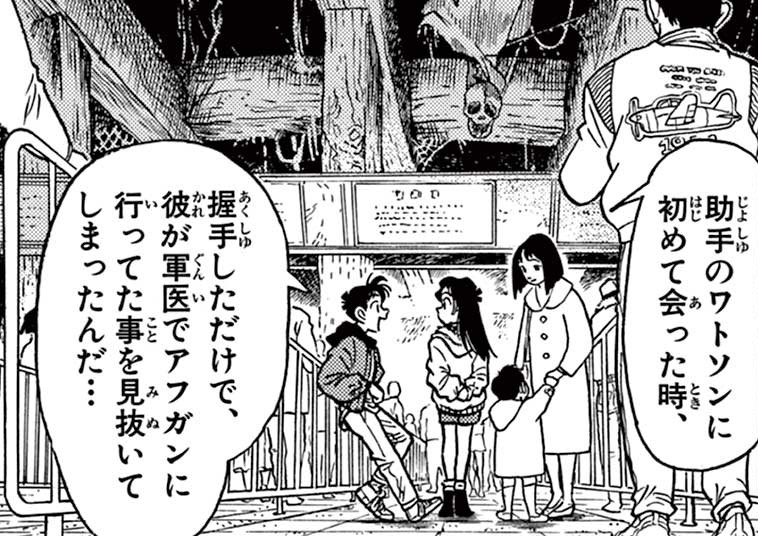
Shin’ichi treats Ran to a day at Tropical Land as a reward for winning the city karate tournament. As they wait in line for a ride on the roller coaster, Shin’ichi explains all the reasons why Sherlock Holmes was the greatest detective.
- 新一:
- 「助手のワトソンに初めて会った時、握手しただけで、彼が軍医でアフガンに行ってた事を見抜いてしまったんだ…」
- “The first time he met his assistant Watson, Holmes could tell just from a handshake that he was a military doctor who had been stationed in Afghanistan...”
- Literal: “When he first met his assistant Watson, just by shaking hands, he saw through the fact that he was a military doctor and had gone to Afghanistan...”
Key Points
- 握手 is the noun “handshake”; adding した makes it the completed action “shook hands”.
- だけで means that this one action alone was enough as the basis for Holmes’s deduction.
- 彼が軍医でアフガンに行ってた事 means “the fact that he was a military doctor and had been to Afghanistan”.
- 事を turns that whole statement into the object of 見抜いてしまった.
- 行ってた is the spoken contraction of 行っていた, “had gone”.
- 見抜く means to see through something and discern the truth; 〜てしまったんだ presents the deduction as already completed and a bit impressive.
Vocabulary
助手 (Assistant)
助手 means an assistant, especially in professional or academic work.
会う (To meet)
会う means to meet or see someone in person.
時 (Time)
時 means time, a moment, or an occasion.
握手 (Handshake)
握手 means a handshake.
彼 (He)
彼 means he or him. In writing, it can retain the older sense of “that person”.
軍医 (Military physician)
軍医 is a military doctor who treats service members and oversees their health. Japan’s Self-Defense Forces use the title 医官.
行く (To go)
行く means to go or move toward a place away from the speaker.
See Also
- Kanji: Gripping and control with 握
- Future entry: Past tense with 〜た・〜だ
- Grammar: Doing completely or ending up doing with 〜てしまう and 〜ちゃう
- Kanji: Hands and skill with 手