Might get along with 〜かもしれない
Grammar Explanation: Might with 〜かもしれない
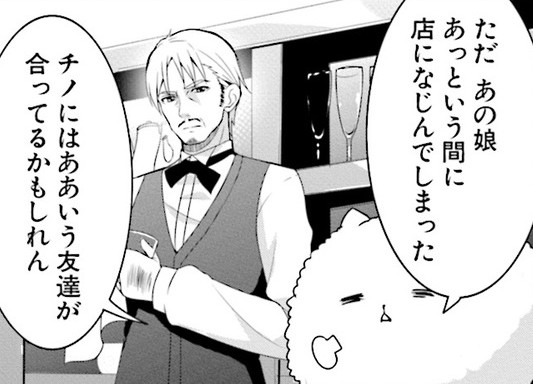
Tippy remarks on how Cocoa adapted immediately to working in the café.
- お父さん:
- 「ただあの娘あっという間に店になじんでしまった」
- “Still, that girl settled into the café in no time.”
- ティッピー:
- 「チノにはああいう友達が合ってるかもしれん」
- “Maybe a friend like that suits Chino.”
- Literal: “For Chino, that kind of friend might suit her.”
Key Points
- Tippy uses the shorter かもしれん to say that a friend like Cocoa may suit Chino.
- に identifies the person for whom the match works, and は makes Chino the contrastive topic.
- Tippy refers to an energetic friend like the one he has just observed, without naming Cocoa in the sentence.
- なじんでしまった presents the change as already complete, to the speaker’s surprise.
Vocabulary
| Word | English | Meaning |
|---|---|---|
| ただ | Just | ただ describes something ordinary or nothing more than it is: “just” or “only”. It also means “free of charge”, often written タダ. |
| あの | That | あの comes before a noun to mean “that” or “those”. It points to someone or something away from both speakers, or something they both know about. |
| 娘 | Daughter | 娘 means daughter. Depending on context, it can also mean a girl or young woman. |
| あっという間に | In an instant | あっという間に describes something happening so fast that there is barely time to say “ah”. |
| 店 | Shop | 店 is a shop, store, or restaurant. |
| なじむ | To fit in | なじむ is to become used to a place or people and feel at home, or for things to blend together well. It is also written 馴染む. |
| ああいう | That kind of | ああいう describes a person or thing like the one being pointed to, or like one both speakers already know about. |
| 友達 | Friend | 友達 means a friend or companion. Despite the suffix 達, it can refer to either one friend or several friends. |
| 合う | To fit | 合う is to fit or match something, or to suit someone. It also means for things to agree, like answers or tastes. |
See Also
- Grammar: Might with 〜かもしれない
- Grammar: Marking the topic with は and も
- Grammar: Doing completely or ending up doing with 〜てしまう and 〜ちゃう
- Grammar: Compound voicing with 連濁
- Kanji: Joining and fitting with 合
- Kanji: Reaching and attaining with 達
- Kanji: Spaces and intervals with 間