Mistaken for poaching with 密漁
Kanji Explanation: Fishing and catches with 漁
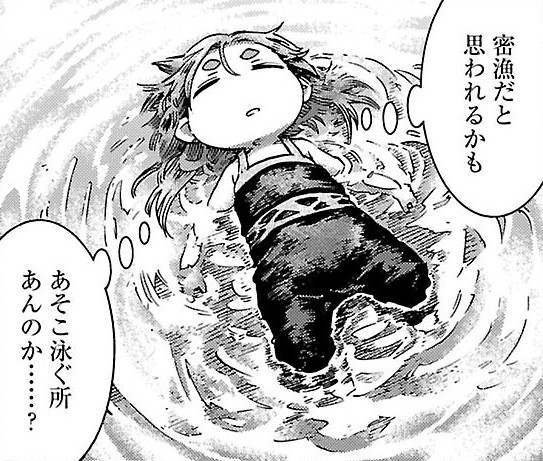
Hakumei can’t swim, so Mimari is teaching her. Hakumei tenses up in the water because she pictures herself drowning, so Mikochi tells her to think about something else, like where she’d go once she can swim. Floating on her back, Hakumei decides she might visit the sea at Arabi with Mikochi. Arabi is a port town known for its seafood.
- ハクメイ:
- 「密漁だと思われるかも」
- “People might think we're poaching.”
- 「あそこ泳ぐ所あんのか……?」
- “Is there even anywhere to swim there...?”
Key Points
- 密漁 is catching fish, shellfish, or other sea life illegally: in a closed area, out of season, or without fishing rights. 密 means secret, and 漁 means fishing, so the word is literally “secret fishing”.
- The 漁 here is read りょう, as in 漁師, a fisherman. In words like 漁港 and 漁業 it is read ぎょ.
- English often says “poaching” for this. Hakumei isn’t planning to catch anything. She only worries that two people splashing around in a fishing town’s waters might look like they are.
- 思われる is the receptive form of 思う, to think. 密漁だと思われる means “to be thought to be poaching”.
- The people who would do the thinking aren’t named. From context they’re the people of Arabi, so “people might think” is a natural translation.
- The だ before と is the copula. A noun such as 密漁 keeps だ before と思う.
- かも is a short form of かもしれない, might. Cutting it short suits a passing thought.
- あんのか is あるのか with る worn down to ん before の. Hakumei is asking herself whether Arabi has any 泳ぐ所, place to swim.
- The trailing ……? shows she has started doubting her own plan.
Vocabulary
| Word | English | Meaning |
|---|---|---|
| 密漁 | Poaching | 密漁 is catching fish, shellfish, or other sea life illegally, such as in a closed area, out of season, or without fishing rights. |
| 思う | Think | 思う is to have a thought, feeling, belief, or hope about something. |
| かも | Might | かも means “might” or “maybe”. It is the casual short form of かもしれない and goes at the end of a sentence to hedge a guess. |
| あそこ | Over there | あそこ is a place away from both the speaker and the listener, or a place both already know about. |
| 泳ぐ | To swim | 泳ぐ is to move through water by moving the arms and legs. |
| 所 | Place | 所 is a place or spot. It also refers to a point in time or an aspect of something. |
| ある | To exist | ある is to exist or be in a place, for things and plants rather than people or animals. It also means to have something, or for an event to take place. |
See Also
- Kanji: Fishing and catches with 漁
- Grammar: Receptive verbs with 〜れる
- Grammar: Quoting and reporting with と and って
- Grammar: The copula だ
- Grammar: Might with 〜かもしれない
- Grammar: How casual contractions work