Misunderstanding an incriminating situation with 誤解
Kanji Explanation: Separating and understanding with 解
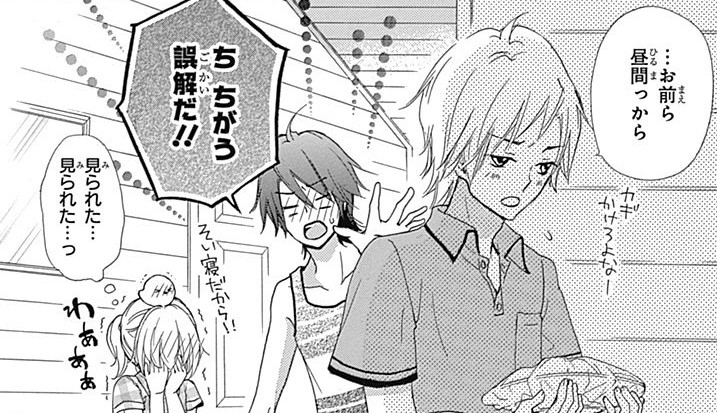
Since Hiyori is resting on a bed inside, Junpei takes a plate from the barbecue to her room. As he walks in, he finds Hiyori and Yuushin in what looks like a compromising position.
- 淳平:
- 「…お前ら昼間っから (カギかけろよなー)」
- “You guys, in the middle of the day… (At least lock the door!)”
- 結心:
- 「ち ちがう 誤解だ!!(そい寝だから!!)」
- “N—No! You've got it wrong!! (We were just lying down together!)”
- Literal: “N-no, that's a misunderstanding!! (We were just sleeping together!!)”
- ひより:
- 「見られた… 見られた…っ」
- “We were seen… We were seen…!”
Key Points
- 誤解 is an incorrect understanding or mistaken interpretation.
- Yuushin uses it because Junpei has interpreted the bed scene as something more suspicious than it was.
- 誤解だ literally says that it is a misunderstanding.
- The plain だ plus exclamation marks make Yuushin sound panicked and forceful.
- ちがう means that something is wrong or not the case.
- The broken first syllable mirrors Yuushin’s panic before he gives the clearer noun 誤解.
- そい寝 is lying down together or sleeping alongside someone.
- The だから supplies the reason the scene looks that way.
Vocabulary
| Word | English | Meaning |
|---|---|---|
| お前ら | You guys | お前ら is a casual, rough way to address two or more people. |
| 昼間 | Daytime | 昼間 is the daytime, while the sun is up. |
| カギ | Key | カギ is a key or lock. カギをかける means to lock something. It is also written 鍵. |
| かける | To hang | かける is to hang something up or put it over something else. It also means to spend time or money, to cause someone trouble, to make a phone call, and more. It is also written 掛ける. |
| ちがう | To differ | ちがう is to be different from something. It also means to be wrong. Said alone, it means “no, that’s not it”. It is also written 違う. |
| 誤解 | Misunderstanding | 誤解 means a misunderstanding or mistaken interpretation of facts or someone’s words. |
| 添い寝 | Sleeping beside | 添い寝 is lying down to sleep next to someone. |
| 見る | To see | 見る is to see, look at, or watch something. It also means to check or judge something, or to look after someone, as in 面倒を見る. |
See Also
- Kanji: Separating and understanding with 解
- Grammar: Past tense with 〜た・〜だ
- Grammar: The copula だ
- Grammar: Receptive verbs with 〜れる
- Grammar: The plain imperative
- Kanji: Daytime and noon with 昼
- Kanji: Seeing and viewpoints with 見
- Kanji: Spaces and intervals with 間