Money on its way with 〜ているところだ
Grammar Explanation: Timing of an action with 〜ところだ
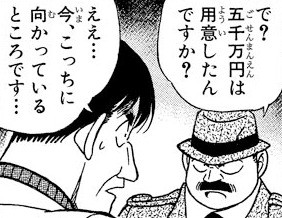
During a soccer match at the national stadium, a caller made TV director Kaneko zoom in on some children in the stands, then had the ball beneath them shot. He threatened to fire into the crowd if the match was stopped. Kaneko has just told Inspector Megure the caller’s demand that Nichiuri TV pack fifty million yen in a bag by halftime.
- 目暮:
- 「で?五千万円は用意したんですか?」
- “So? Have you got the fifty million yen ready?”
- 金子:
- 「ええ…今、こっちに向かっているところです…」
- “Yes... It's on its way here now...”
Key Points
- A 〜ている verb plus ところだ says the action is under way at this moment. ところです is the polite form, fitting for a TV director talking to a police inspector.
- 向かっている alone could mean “is heading here”. ところです pins it to the present stage. The money has set out but hasn’t arrived. 今 backs up that timing.
- 向かう means “to head toward”, and に marks where. こっち is the casual form of こちら, “this way”, so こっちに向かう is “head here”.
- Kaneko doesn’t say who is bringing the money. Japanese leaves that out when it’s clear, and English can use “it”.
- Megure makes the money the topic with 五千万円は. Kaneko’s reply keeps that topic without repeating it, so “the money” is the unspoken subject of 向かっている.
- で? at the start is a clipped それで, “so?”, pushing Kaneko to get to the point. 〜んですか asks for the situation to be explained.
Vocabulary
五 (Five)
五 is the number five. It combines with larger units to build amounts, as in 五千万円, “fifty million yen”.
千 (Thousand)
千 is the number one thousand. It also works as a unit inside larger numbers, as in 五千万, five thousand ten-thousands, or fifty million.
万 (Ten thousand)
万 is ten thousand, the basic unit for large numbers in Japanese. Amounts above it count in 万, so fifty million is 五千万, “five thousand 万”.
円 (Yen)
円 is the yen, Japan’s currency. It follows a number to give an amount of money. It also means a circle.
今 (Now)
今 is the present moment, or these days.
こっち (Over here)
こっち is a casual word for “this way”, “here”, or “this one”. It can also mean “our side” or “me”.
向かう (To head toward)
向かう means to head toward a place or person, often with に or へ. It can also mean to face something.
ところ (Place)
ところ is a place or spot. It also refers to a point in time or a certain aspect of something. It is also written 所.
See Also
- Grammar: Timing of an action with 〜ところだ
- Grammar: Ongoing actions and resulting states with 〜ている
- Grammar: Marking the topic with は and も
- Grammar: Polite style with です and ます
- Kanji: Now and the present with 今
- Kanji: Thought and intention with 意