Nearly turning to ash with 〜ってば
Grammar Explanation: Insisting with 〜ってば
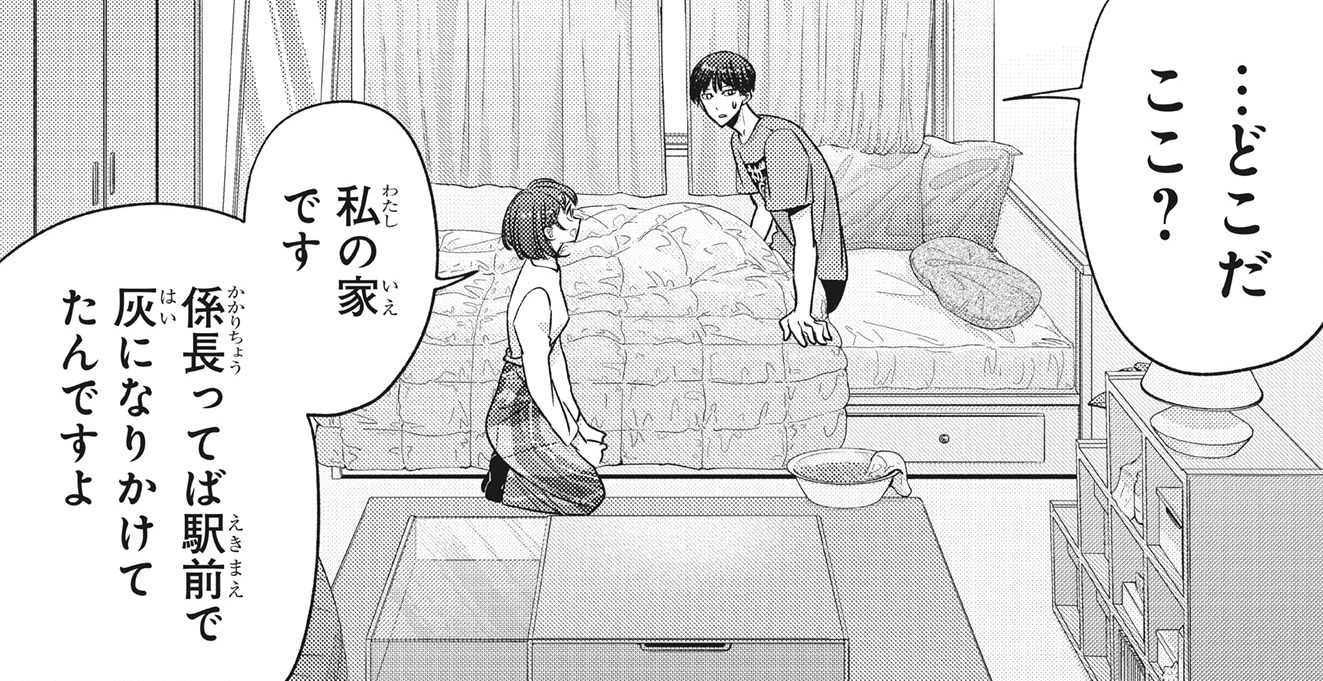
Kumada, a section chief who avoids other people, has spent the night being dragged into one subordinate’s home after another. Worn out, he slumped on the steps by the station, where Akagi, another of his subordinates, found him. He passed out, and he has just woken up in a bed he doesn’t recognize.
- 熊田:
- 「…どこだここ?」
- “…Where am I?”
- 赤城:
- 「私の家です 係長ってば駅前で灰になりかけてたんですよ」
- “My place. Honestly, sir, you were about to turn to ash outside the station.”
Key Points
- 係長ってば makes Kumada the topic, and the rest of the sentence comments on him. The tone is “honestly, you…”: Akagi is half scolding, half teasing.
- Kumada is right there listening. Japanese often uses a title like 係長 where English would say “you”, so the comment is aimed straight at him.
- 灰になる is “turn to ash”. The masu-stem plus かける means “start to” or “be on the verge of”, so なりかける is “almost become”.
- かけてた is the casual form of かけていた, “was on the verge of”. On the previous pages, Kumada is drawn crumbling away like ash, a manga way of showing total exhaustion.
- んです explains the situation, and よ tells Kumada something he doesn’t know. He doesn’t remember how he got here, so Akagi fills him in.
Vocabulary
どこ (Where)
どこ asks what place something is in.
ここ (Here)
ここ is the place where the speaker is.
私 (I)
私 means “I” or “me”. It is the standard first-person pronoun in polite speech and is also common in casual speech among women.
家 (House)
家 is a building where people live.
灰 (Ash)
灰 is ash, the powder left after something burns.
なる (To become)
なる is to change into a different state or become something. It also means something turns out a certain way. It is also written 成る.
かける (To hang)
かける is to hang something up or put it over something else. It also means to spend time or money, to cause someone trouble, to make a phone call, and more. It is also written 掛ける.
See Also
- Grammar: Insisting with 〜ってば
- Grammar: Becoming with 〜くなる and 〜になる
- Grammar: Reasoning with 〜のだ
- Grammar: Informing with よ
- Kanji: Homes and specialists with 家
- Kanji: Privacy and self with 私