Never even held a kitchen knife with 包丁を握る
Vocabulary Explanation: Collocations for cooking
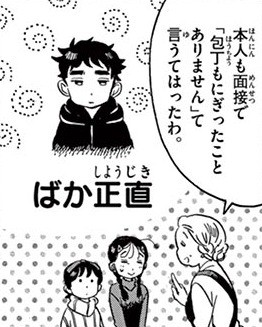
Kiyo and Sumire visit a Western-style restaurant whose card their childhood friend Kenta left them, guessing he works there as a waiter. When they can’t cover the bill, the woman serving them says a staff member already paid for their meal out of his wages. That turns out to be Kenta, who works in the kitchen as an apprentice cook. Sumire admits the news surprised them, since Kenta never used to cook.
- 店員さん:
- 「本人も面接で『包丁もにぎったことありません』て言うてはったわ。」
- “He said so himself at his interview. 'I've never even held a kitchen knife.'”
- Literal: “The person himself also said at the interview, "I have never even gripped a kitchen knife."”
- ー:
- 「ばか正直」
- “Honest to a fault”
Key Points
- 握る means to grip something firmly in your hand. With 包丁, it means to take up a knife and cook.
- 包丁も握ったことがない is a set way of saying someone has never cooked, not even the first step.
- The manga writes the verb in kana, にぎった. The same verb shapes rice balls: おにぎりを握る.
- も replaces the object particle を. With a negative verb, it means “not even”: Kenta hasn’t done even the most basic thing.
- 本人も at the start is a different も, “too”. The woman heard the same thing from Kenta himself, not just from his friends.
- 〜たことがない says something has never happened to you. ありません is the polite form of ない, which suits a job interview.
- Speakers often drop が in this pattern, as Kenta does: にぎったことありません.
- て after a quote is the Kansai counterpart of って, the casual quotation marker.
- 言うて is the Kansai て-form of 言う. Standard Japanese says 言って.
- 〜てはった is the past of 〜てはる, the Kyoto form of 〜ている with respect added. In Kyoto, はる also shows friendly consideration, which is why the woman uses it for her own young employee.
- Her sentence-final わ softens the statement.
- ばか before 正直, “honest”, means “foolishly”. Kenta was so honest that he admitted the one thing likely to cost him the job.
Vocabulary
本人 (The person themselves)
本人 is the very person being talked about, as opposed to a relative, a friend, or a stand-in.
面接 (Interview)
面接 is meeting an applicant in person to judge them, as for a job or a school place.
包丁 (Kitchen knife)
包丁 is the knife used for cooking. Kinds are named by what they cut, such as a 出刃包丁 for fish.
握る (To grip)
握る means to grip or squeeze something in your hand. It is also the verb for shaping food by hand, as in おにぎりを握る or 寿司を握る, and for holding power or control, as in 権力を握る.
こと (Thing)
こと is an abstract thing, matter, or fact, as opposed to a physical object. It also turns a verb phrase into a noun, as in 見たことがある. It is also written 事.
ある (To exist)
ある is to exist or be in a place, for things and plants rather than people or animals. It also means to have something, or for an event to take place.
言う (To say)
言う means to say or tell. It can also mean to call something by a particular name.
ばか正直 (Honest to a fault)
ばか正直 describes someone so honest that it works against them, telling the truth even when a small fib or silence would serve them better.
See Also
- Vocabulary: Collocations for cooking
- Grammar: Previous experience with 〜た+ことがある
- Grammar: Grammar in the Kansai dialect
- Kanji: Faces and surfaces with 面
- Kanji: Gripping and control with 握
- Kanji: Origins and main things with 本
- Kanji: People and persons with 人