Never messing up rice balls with おにぎりを握る
Vocabulary Explanation: Collocations for cooking
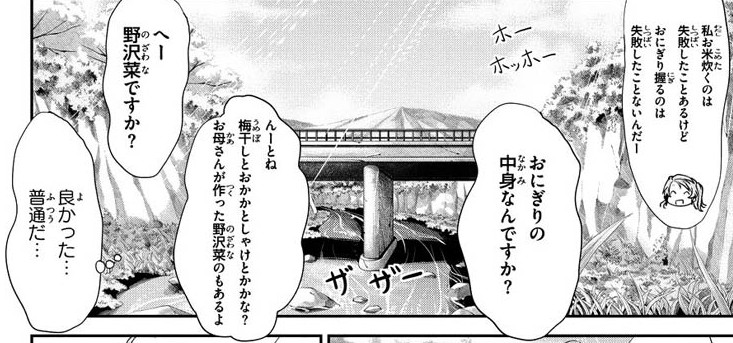
Hotaru and Komari agreed to trade homemade lunches while viewing the cherry blossoms. Komari’s lunch came out badly, with burnt noodles and a hamburger covered in melted chocolate, but Hotaru ate it anyway and insisted it was delicious. Now Komari offers her a rice ball, and Hotaru takes a bite and finds it good.
- 小鞠:
- 「私お米炊くのは失敗したことあるけどおにぎり握るのは失敗したことないんだー」
- “I've messed up cooking rice before, but I've never messed up making rice balls!”
- Literal: “As for cooking rice, I have failed, but as for shaping rice balls, I have never failed.”
- 蛍:
- 「おにぎりの中身なんですか?」
- “What's in the rice balls?”
- 小鞠:
- 「んーとね 梅干しとおかかとしゃけとかかな? お母さんが作った野沢菜のもあるよ」
- “Let's see... pickled plum, bonito flakes, salmon, that kind of thing? There's also one with the nozawana pickles my mom made.”
- 蛍:
- 「へー 野沢菜ですか?」
- “Oh, nozawana?”
- 「良かった… 普通だ…」
- “Thank goodness... They're normal...”
Key Points
- 握る means to grip or squeeze. Rice balls are pressed into shape by hand, so Japanese says you 握る them. English “make” fits better in a translation.
- The noun おにぎり comes from the same verb: お plus 握り, “something squeezed.”
- Komari drops the particle を in both phrases: お米炊く and おにぎり握る. Casual speech often leaves out を.
- 炊く is the verb for cooking rice. Komari lines it up against 握る to separate the two steps. Cooking the rice is where she has gone wrong. Shaping it is where she never has.
- The の after each verb turns it into a noun phrase, and は makes that phrase the topic. With two topics side by side, the は also sets them in contrast.
- 〜たことがある says something has happened at least once. 〜たことがない says it never has. Komari drops the が in both halves.
- けど joins the two halves: “I’ve failed at this, but not at that.”
- んだ presents the last part as something Komari wants Hotaru to know. The stretched ー makes it sound pleased and a bit proud.
- なん here is 何, “what”, not explanatory んです. The full question is おにぎりの中身は何ですか, with は dropped.
- とか marks the list as examples, not a full list. かな adds that Komari isn’t quite sure.
- お母さんが作った野沢菜の is “the one with nozawana my mom made.” The final の stands in for おにぎり.
- Hotaru says this in her head. After the chocolate-covered hamburger, she’s relieved the fillings are ordinary ones.
Vocabulary
私 (I)
私 means “I” or “me”. It is the standard first-person pronoun in polite speech and is also common in casual speech among women.
お米 (Rice)
お米 is uncooked rice, the grains before they are cooked. The お makes it sound polite and gentle, and most speakers use it in everyday talk. Once cooked, rice is called ご飯.
炊く (To cook rice)
炊く is to cook rice or other grains by boiling them until the water is absorbed, as in ご飯を炊く. In western Japan, it also means to simmer other foods.
失敗 (Failure)
失敗 is not getting the result one tried for. It covers a small slip as well as a plan that falls through. It takes する.
する (To do)
する is to do or perform something. It also turns many nouns into verbs, as in 勉強する.
こと (Thing)
こと is an abstract thing, matter, or fact, as opposed to a physical object. It also turns a verb phrase into a noun, as in 見たことがある. It is also written 事.
ある (To exist)
ある is to exist or be in a place, for things and plants rather than people or animals. It also means to have something, or for an event to take place.
おにぎり (Rice ball)
おにぎり is rice pressed into a triangle or round shape, often with a filling and wrapped in seaweed.
握る (To grip)
握る means to grip or squeeze something in your hand. It is also the verb for shaping food by hand, as in おにぎりを握る or 寿司を握る, and for holding power or control, as in 権力を握る.
中身 (Contents)
中身 is what is inside a container. It is also what a person or thing is really like under the surface.
梅干し (Pickled plum)
梅干し is a Japanese plum (ume) salted and dried until it is very sour. It is a common filling for rice balls and a standard part of a lunch box.
おかか (Bonito flakes)
おかか is finely shaved dried bonito (かつお節), often mixed with soy sauce. It is a common rice ball filling.
しゃけ (Salmon)
しゃけ is salmon, especially as food. It is a casual pronunciation of さけ, and both are written 鮭. Salted, grilled salmon is a standard rice ball filling.
お母さん (Mom)
お母さん is a polite, warm word for mother. Children use it to call their own mother, and it also refers to someone else’s mother.
作る (To make)
作る means to create or prepare something.
野沢菜 (Nozawana)
野沢菜 is a leafy green in the turnip family, usually eaten pickled. It is a specialty of Nagano Prefecture.
良い (Good)
良い describes something good or proper. 良かった means “I’m glad” or “it was good”.
普通 (Ordinary)
普通 describes what is usual and unremarkable, neither special nor odd. 普通に is used loosely for honestly or just normally.
See Also
- Vocabulary: Collocations for cooking
- Grammar: Previous experience with 〜た+ことがある
- Grammar: But with 〜けど and 〜けれど
- Grammar: Reasoning with 〜のだ
- Grammar: Wondering with かな
- Kanji: Gripping and control with 握
- Kanji: Making and creating things with 作
- Kanji: Privacy and self with 私