Never more grateful than today with 〜ほど〜ない
Grammar Explanation: Not as much as with 〜ほど〜ない
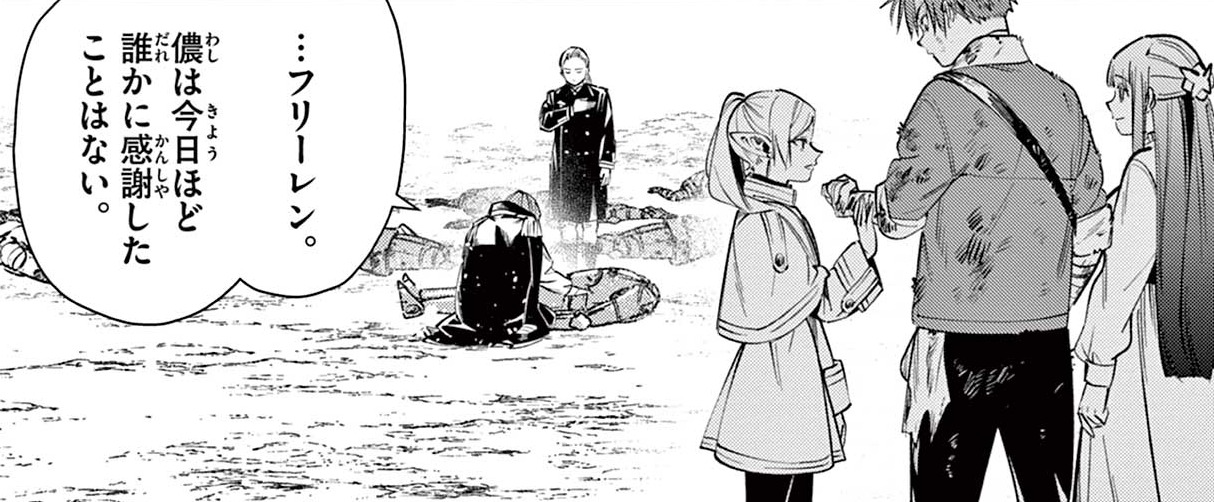
Frieren has defeated Aura the Guillotine, whose undead army was made of fallen northern warriors. Count Granat thanks the party for bringing the warriors down with so little damage to their bodies, and orders his soldiers to give them a proper burial. Among the bodies, he finds a suit of armor with the Granat family crest hanging from its neck. It belonged to his son, who died in battle.
- グラナト伯爵:
- 「…フリーレン。」
- 「儂は今日ほど誰かに感謝したことはない。」
- “...Frieren.”
- “I have never been as grateful to anyone as I am today.”
Key Points
- In the usual ⒶはⒷほど〜ない, Ⓐ falls short of Ⓑ. In Ⓑほど〜はない, nothing falls short of Ⓑ, because nothing reaches it. The count’s yardstick is 今日, and the “nothing” is every past occasion: he has never been as grateful as today.
- English usually turns this around into a superlative: “I have never been more grateful.” Japanese says it as a comparison that every other time fails.
- This is the speaker’s own judgment, not a measurement. The count is speaking from feeling, a moment after finding his son’s armor.
- Plain past verb + ことがない says the experience has never happened. 感謝したことがない is “have never been grateful”.
- The count uses は in place of が. は puts weight on the lack of experience, and it is the usual particle in the Ⓑほど〜はない frame.
- 感謝する is “to thank” or “to be grateful”. The person thanked takes に.
- 誰か is “someone”. He uses it, not 誰も, because the negative ない belongs to ことはない rather than to 誰か. The sense is “I have never been this grateful to anyone, whoever it was”.
- 儂 is a first-person pronoun used mostly by older men. Fiction often gives it to elderly or authoritative characters, and it suits the gruff count.
- It is usually written in kana, as わし. The kanji spelling is rare.
Vocabulary
儂 (I)
儂 is a word for “I” used mostly by older men. It is the kanji spelling of わし, which is usually written in kana.
今日 (Today)
今日 means today. In formal writing, it can also mean the present day or current era.
ほど (Extent)
ほど is the degree or extent of something: “about” or “as much as”. 〜ば〜ほど means “the more…, the more…”.
誰か (Someone)
誰か is some person who is not named or not known.
感謝 (Gratitude)
感謝 means gratitude or thanks for someone’s kindness or help.
する (To do)
する is to do or perform something. It also turns many nouns into verbs, as in 勉強する.
こと (Thing)
こと is an abstract thing, matter, or fact, as opposed to a physical object. It also turns a verb phrase into a noun, as in 見たことがある. It is also written 事.
ない (Not)
ない means something does not exist or someone does not have it. After a verb, it makes the verb negative. It is also written 無い.
See Also
- Grammar: Not as much as with 〜ほど〜ない
- Grammar: Previous experience with 〜た+ことがある
- Kanji: Now and the present with 今