No excuse to laze around with 〜わけじゃない
Grammar Explanation: Not necessarily with 〜わけではない
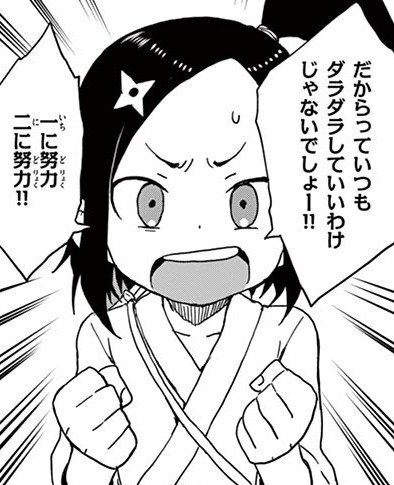
The teacher has declared a day of team-against-team battles. Benisumomo, a senior on Touwata’s team, challenges Tsubaki’s team, and Tsubaki accepts. Sazanka whispers that they should pick another team, since Touwata never gives up, Mizubashou is too good at setting traps, and Benisumomo is extremely strong. Benisumomo overhears and agrees: “Well, I am a genius.”
- トウワタ:
- 「だからっていつもダラダラしていいわけじゃないでしょー!!」
- “That doesn't mean you get to laze around all the time!!”
- Literal: “Even so, it isn't the case that it's okay to always laze around, right!!”
- 「一に努力二に努力!!」
- “Effort first, effort second!!”
- Literal: “First, effort. Second, effort!!”
Key Points
- わけじゃない is the casual form of わけではない. It rejects a conclusion that someone might draw.
- だからって is casual だからといって, “even so” or “just because of that”. It points back to Benisumomo’s claim that she’s a genius.
- Touwata doesn’t dispute the talent. She rejects the conclusion Benisumomo draws from it: that a genius can skip the hard work.
- ダラダラ describes doing things slowly and idly, without purpose. ダラダラする means “to laze around” or “to slack off”.
- 〜ていい is 〜てもいい with the も dropped: “it’s okay to…”.
- いつも sits inside the denied part. Touwata isn’t banning rest. She objects to slacking all the time.
- でしょ here isn’t a guess. With the stretched vowel and exclamation marks, it presses a point Touwata thinks Benisumomo should already accept: “come on, you know that!”
- 一に〜二に〜 lists what matters most: “first…, second…”. Naming 努力 in both slots means effort comes first and second.
- In the next panel she keeps going: 三、四も同じく五も努力っスよ, “three and four are the same, and five is effort too”.
Vocabulary
いつも (Always)
いつも describes what happens all the time, or what is normal for someone.
ダラダラ (Idly, sluggishly)
ダラダラ describes doing something slowly and idly, with no energy or purpose, as in ダラダラする, “to laze around”. It can also describe liquid dripping steadily or something dragging on too long. It is also written だらだら.
する (To do)
する is to do or perform something. It also turns many nouns into verbs, as in 勉強する.
いい (Good)
いい describes something good, nice, or fine. It can also mean “okay” or “that’s enough”. Its other forms come from よい, as in よくない and よかった.
わけ (Reason)
わけ is a reason or meaning. It also appears in grammar patterns such as わけがない, “there’s no way”, and わけにはいかない, “can’t very well”.
一 (One)
一 is the number one. It can also mean “first” or “the best”, as in 一に努力, “effort first”.
二 (Two)
二 is the number two, and it can also mean “second”.
努力 (Effort)
努力 means sustained effort or hard work toward a goal.
See Also
- Grammar: Not necessarily with 〜わけではない
- Grammar: Permission to do with 〜てもいい
- Grammar: Presuming with 〜だろう and 〜でしょう