No more victims with 犠牲者
Kanji Explanation: Sacrifice and offerings with 犠
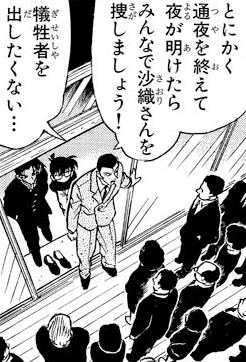
Another woman has been strangled during a wake, and the killer took her Dugong Arrow, a sacred arrow from the island’s festival. Saori is still missing, and she had also lost her arrow. Her father sneers that she may have turned into a mermaid. Kazuha shudders as she recalls the island’s old woman warning that a girl who lets go of her arrow will return to the water as a mermaid.
- 小五郎:
- 「とにかく通夜を終えて夜が明けたらみんなで沙織さんを捜しましょう!」
- “Anyway, let's get through the wake, and once the sun comes up, we'll all search for Saori!”
- 「犠牲者を出したくない…」
- “I don't want any more victims...”
Key Points
- 犠牲者 joins 犠牲, a sacrifice or loss, with 者, a person. It names someone who is killed or seriously harmed by a crime, accident, or disaster.
- The victims don’t choose their fate. Here the word means people killed by the murderer.
- 出す usually means to take something out. With 犠牲者, it means to allow victims to result. News reports use the same phrase for disasters.
- 出したくない adds 〜たくない, “don’t want to”. Two people have already died, so “any more victims” fits the English.
- 通夜を終えて uses the て-form to line up the first step, finishing the wake. 夜が明けたら sets the next one: once night ends and day breaks.
- 捜しましょう is the polite “let’s search,” which Kogoro uses for the islanders.
- とにかく sets aside the mermaid talk and moves to what they should do next.
Vocabulary
| Word | English | Meaning |
|---|---|---|
| とにかく | Anyway | とにかく sets other matters aside to focus on the main point: “in any case”. |
| 通夜 | Wake | 通夜 is a wake, the gathering on the night before a funeral when family and friends keep watch over the deceased and offer condolences. |
| 終える | To finish | 終える is to finish doing something. |
| 夜が明ける | Dawn breaks | 夜が明ける means night comes to an end and day begins to break. |
| みんな | Everyone | みんな means all the people in a group, or everything. It is also written 皆. |
| 捜す | To search for | 捜す is to search for someone or something that has gone missing, such as a lost item, a missing person, or a suspect. For something you want but don’t have yet, the usual spelling is 探す. |
| 出す | To put out | 出す is to take something out, send it out, or hand it in. After a verb stem, it means to start doing something. |
See Also
- Kanji: Sacrifice and offerings with 犠
- Grammar: Wanting to do with 〜たい
- Grammar: If and when with 〜たら
- Grammar: Connecting actions with 〜て・〜で
- Grammar: Polite style with です and ます
- Kanji: Going out and emerging with 出