No reason to stay in the village with 留まる
Vocabulary Explanation: Stopping, fastening, and staying over with とまる
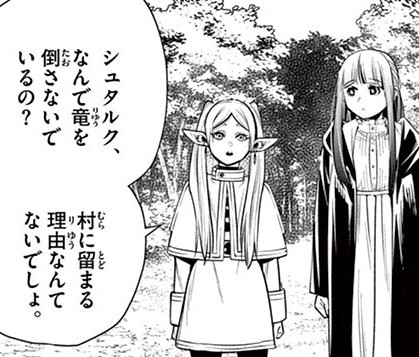
Frieren and Fern have come to a village by the Riegel Canyon to recruit Stark, a warrior Eisen told them about. The villagers say Stark faced down the dragon that attacked them three years ago, and that it hasn’t returned while he’s been there. Frieren and Fern have tried fighting the dragon themselves and fled. Stark has just learned they know his master.
- フリーレン:
- 「シュタルク、なんで竜を倒さないでいるの?」
- “Stark, why haven't you killed the dragon?”
- 「村に留まる理由なんてないでしょ。」
- “It's not like you have any reason to stay in this village.”
Key Points
- 留まる read とどまる means staying in a place instead of moving on. 村に留まる is “stay in the village”.
- The same kanji read とまる is being fastened in place. Staying the night is a different word, 泊まる. Here the furigana tells you which reading the author means.
- 倒さないでいる is 倒す, “defeat”, in the 〜ないでいる pattern: staying in a state of not doing something. Frieren is asking why Stark keeps leaving the dragon alive.
- Ending the question with の asks for an explanation: なんで〜の? is “why is it that…?”
- なんて after a noun waves it off as unlikely or not worth much. 理由なんてない is “there’s no reason at all”, stronger than a plain 理由はない.
- でしょ is short for でしょう. Frieren states it as something Stark should agree with: “You’ve got no reason to stay, right?”
Vocabulary
| Word | English | Meaning |
|---|---|---|
| なんで | Why | なんで asks for the reason something happens. It is more casual than どうして. |
| 竜 | Dragon | 竜 is a dragon, a huge mythical reptile. It is also read たつ, and also written 龍. |
| 倒す | To defeat | 倒す is to knock something down. It also means to defeat an opponent. |
| 村 | Village | 村 is a village, a small community in the countryside. |
| 留まる | To be fastened; to stay | 留まる is for something to be held in place, such as by a pin or a screw. Read とどまる, it means to stay or remain somewhere instead of moving on. |
| 理由 | Reason | 理由 is why something is so or was done. 理由がある is to have a reason, and 理由もなく is for no reason. |
| なんて | Such a thing as | なんて follows a word to treat it lightly or with surprise: “things like” or “such a thing as”. At the start of a phrase, it means “what a…!” |
| ない | Not | ない means something does not exist or someone does not have it. After a verb, it makes the verb negative. It is also written 無い. |
See Also
- Vocabulary: Stopping, fastening, and staying over with とまる
- Grammar: Without doing and please don't with 〜ないで
- Grammar: Presuming with 〜だろう and 〜でしょう
- Grammar: Reasoning with 〜のだ