No time to leisurely eat with 呑気
Vocabulary Explanation: Carefree with 呑気
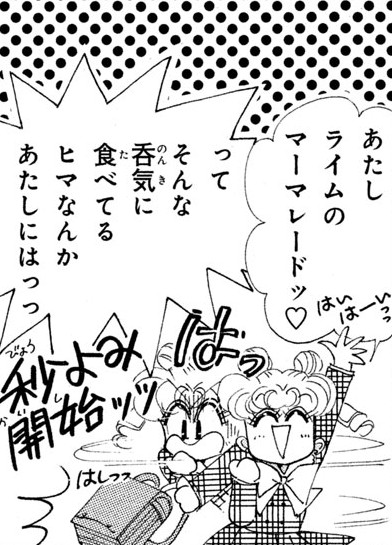
After an enemy attack changes Usagi and Mamoru into kids, Usagi wakes to find the two of them living together as a couple. As Usagi wanders into the dining room, Mamoru is placing a plate of french toast on the table. He greets her and asks Usagi what type of jam she wants on her toast. Usagi responds, then realizes she needs to get to school.
- うさぎ:
- 「あたし ライムのマーマレードッ」
- “I'll have lime marmalade!”
- 「ってそんな呑気に食べてるヒマなんかあたしにはっっ」
- “Ah, I don't have any time to be leisurely eating!”
- Literal: “Wait, I don't have time to be eating so carefree!!”
Key Points
- The に turns 呑気 into an adverb, so it describes how she would be eating.
- In this scene it means eating in a relaxed, unconcerned way despite needing to get to school.
- 食べてる drops the い from 食べている, a common spoken contraction.
- The phrase is not about one bite; it pictures spending time sitting there eating.
- なんか downplays free time as something she absolutely does not have.
- The order puts あたしには late, emphasizing that for Usagi there is no time for this.
Vocabulary
| Word | English | Meaning |
|---|---|---|
| あたし | I | あたし means “I” or “me”. It is a casual, feminine form of 私. |
| ライム | Lime | ライム is a lime, the green citrus fruit. |
| マーマレード | Marmalade | マーマレード is marmalade, a jam made from citrus fruit and its peel. |
| そんな | Like that | そんな describes something like the thing just mentioned. Said alone, it shows shock or denial: “no way!” |
| 呑気 | Carefree | 呑気 means carefree, easygoing, or optimistic. Depending on the context, it can sound warm and approving or criticize someone for being careless and unconcerned. |
| 食べる | To eat | 食べる is to put food in your mouth, chew, and swallow it. |
| ヒマ | Free time | ヒマ is free time with nothing to do. It is also written 暇. |
| なんか | Something | なんか is a casual form of なにか, “something”. After a noun, it means “things like” or “someone like”, often looking down on it. It also means “kind of” or “somehow”. |
See Also
- Vocabulary: Carefree with 呑気
- Grammar: Marking the topic with は and も
- Grammar: Ongoing actions and resulting states with 〜ている
- Kanji: Eating and food with 食