No way he can win with 〜っこない
Grammar Explanation: A strong denial with 〜っこない
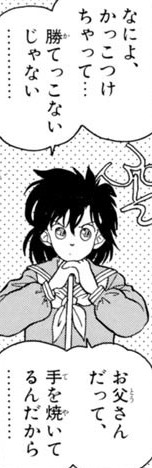
As he performs one trick after another, Kaito says he’s unbeatable at magic. Aoko says he can’t win against Kaitou Kid, the magic-using thief her police father has yet to apprehend. Kaito disregards the claim and continues disrupting class with his tricks.
- 青子:
- 「なによ、かっこつけちゃって… 勝てっこないじゃない……」
- “What's with all that showing off? There's no way he can win.”
- Literal: “What is that, acting cool... There is no way he can win, is there...”
- 「お父さんだって、手を焼いてるんだから」
- “Even Dad is having a hard time of it.”
Key Points
1〜っこない is emphatic impossibility
- 勝てっこない says winning is not merely unlikely; Aoko treats it as impossible.
- It attaches to the verb stem: 勝てる becomes 勝てっこない.
2The target is understood from context
- The line does not repeat Kaitou Kid, but the previous exchange makes him the person Kaito supposedly cannot beat.
- じゃない turns the claim into a pointed assertion.
3だって supports the judgment with evidence
- お父さんだって means “even Dad”, strengthening the argument because her police father struggles too.
- Aoko is not just insulting Kaito’s confidence; she backs it up by pointing to someone more experienced.
4手を焼く = to be at one’s wits’ end with something
- 手を焼いてる is the progressive form, so her father is currently having a hard time dealing with Kaitou Kid.
- The idiom often implies that the problem is troublesome to handle, not just briefly difficult.
- さん is an honorific suffix attached to a person’s name to show respect and social distance, roughly equivalent to “Mr.”, “Ms.”, or “Mrs.” in English, though it’s used far more broadly and doesn’t specify gender or marital status.
See Also
- Grammar: A strong denial with 〜っこない
- Grammar: Connecting actions with 〜て・〜で
- Grammar: Doing completely or ending up doing with 〜てしまう and 〜ちゃう
まじっく快斗 © its respective creators. It is used here for educational commentary.