No wonder it's cold with 道理で〜わけだ
Grammar Explanation: Logical conclusion with 〜わけだ
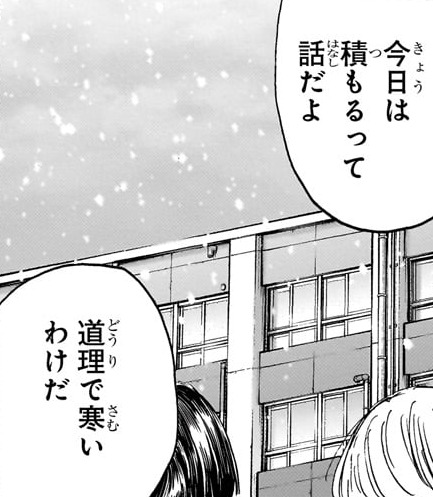
It’s December, three days before the Winter Cup, and the weather report has warned of a major cold wave with snow. As the basketball team heads to practice, snow starts to fall.
- 生徒Ⓐ:
- 「今日は積もるって話だよ」
- “They say it's going to pile up today.”
- 生徒Ⓑ:
- 「道理で寒いわけだ」
- “No wonder it's so cold.”
Key Points
- わけだ presents a statement as making sense given known facts. Here the known fact is the snow, and the statement it explains is 寒い.
- 道理で means “that’s why” or “no wonder”. It often comes before わけだ when a speaker suddenly understands the reason for something they already noticed.
- The cold isn’t new information. She’d felt it already. What’s new is the reason, so the line works as a realization, not a prediction.
- 寒い is an い-adjective, so it attaches to わけだ directly. A noun or な-adjective would take な first: 雪なわけだ, 静かなわけだ.
- 積もる means for snow to pile up on the ground.
- って is casual という, and 〜って話だ passes on something heard: “they say…”. The first student is likely repeating the forecast.
- よ offers this as news to her teammate.
Vocabulary
今日 (Today)
今日 means today. In formal writing, it can also mean the present day or current era.
積もる (To pile up)
積もる means to pile up or build up, as snow or dust settles in layers. It’s also used for feelings or worries that build up over time.
話 (Talk)
話 is a talk or conversation. It also means a story, or what someone said.
道理で (No wonder)
道理で says that the reason for something has just become clear: “no wonder” or “that explains it”. It often pairs with わけだ or はずだ at the end of the sentence.
寒い (Cold)
寒い describes cold weather or air, or feeling cold.
わけ (Reason)
わけ is a reason or meaning. It also appears in grammar patterns such as わけがない, “there’s no way”, and わけにはいかない, “can’t very well”.
See Also
- Grammar: Logical conclusion with 〜わけだ
- Grammar: Quoting and reporting with と and って
- Grammar: Informing with よ
- Grammar: Marking the topic with は and も
- Kanji: Now and the present with 今