Nobody in the interview room with いざ入ったら
Grammar Explanation: When the time comes with いざ〜となると
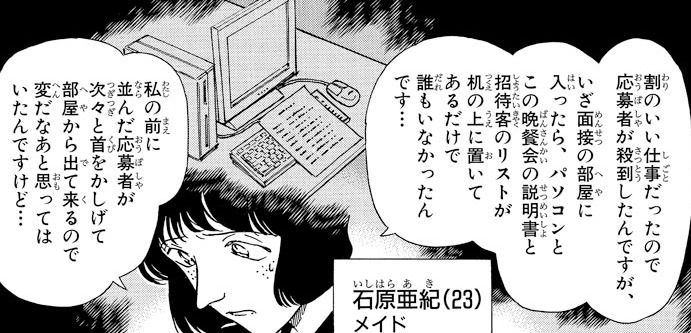
Kogoro, Ran, and Conan have arrived at a remote mansion whose owner has invited several famous detectives to dinner. The maid who greets them admits she has never met the owner. Asked about the guest list, she says she was given it at her job interview, and that the interview was a strange one.
- 亜紀:
- 「割のいい仕事だったので応募者が殺到したんですが、いざ面接の部屋に入ったら、パソコンとこの晩餐会の説明書と招待客のリストが机の上に置いてあるだけで誰もいなかったんです…」
- “It paid well, so applicants came flooding in. But when I actually went into the interview room, there was just a computer, instructions for this dinner party, and the guest list on the desk. Nobody was there…”
- Literal: “Because (it) was a good-paying job, applicants rushed in, but when (I) actually entered the interview room, a computer, this dinner party's instructions, and the guest list were only placed on top of the desk, and nobody was there.”
- 「私の前に並んだ応募者が次々と首をかしげて部屋から出て来るので変だなあと思ってはいたんですけど…」
- “The applicants in line ahead of me came out of the room one after another, looking puzzled, so I did think it was odd…”
- Info Card:
- 「石原亜紀(23) メイド」
- “Aki Ishihara (23), maid”
Key Points
- いざ stresses that the moment had really come. Aki had applied and waited in line, and now it was her turn.
- たら followed by a past event tells what happened once the first action took place. Here it is what she found on walking in: a desk with papers and nobody there. It isn’t a condition.
- Compare いざ入るとなると, “when it actually came to going in”. That looks at the point just before acting. Aki is reporting what she saw after going in, so たら fits.
- 〜てある describes things someone put in place and left there. Someone set out the computer and the papers ahead of time.
- だけ means “only”. The items on the desk were all there was. で links this to 誰もいなかった, “and nobody was there”.
- んです is the polite form of のだ. Aki is giving background to explain why she has never met the owner.
- が in 殺到したんですが sets up a contrast: lots of applicants, but no one to interview them. The second bubble trails off with けど, leaving her doubts unspoken.
- 首をかしげる is a gesture of doubt or confusion. The applicants before her came out of the room looking puzzled, one after another, which is why she already thought something was odd.
Vocabulary
割のいい (Well-paying)
割のいい describes work or a deal that pays well for the effort it takes. It’s also said 割がいい.
仕事 (Work)
仕事 is work done for a living, or a particular task one has to do.
いざ (Actually, for real)
いざ marks the moment something stops being a plan and has to be done for real, as in いざ買うとなると, “when it actually comes to buying”. On its own, it’s an old-fashioned “Now then!” said before starting something.
部屋 (Room)
部屋 means a room separated from other spaces in a building.
入る (To enter)
入る is to go into a place, or for something to be inside. It also means to join a club or school.
パソコン (Personal computer)
パソコン is a personal computer. It’s short for パーソナルコンピューター.
この (This)
この means “this” or “these” and comes directly before a noun. It points to something near the speaker or something the speaker is referring to in the conversation.
晩餐会 (Dinner party)
晩餐会 is a formal dinner party or banquet.
説明書 (Instructions)
説明書 is a written explanation, such as an instruction manual or an explanatory leaflet.
招待客 (Invited guest)
招待客 is a guest who has been invited to an event.
リスト (List)
リスト is a list of names or items.
上 (Top)
上 means the top of something or the space above it, as in 机の上, “on the desk”. It can also mean higher in rank or older.
置く (To put)
置く is to put something somewhere or leave it there. After a て-form verb, 〜ておく means doing something in advance.
いる (To be)
いる is to exist or be somewhere, for people and animals. After a て-form verb, it shows an ongoing action or a continuing state.
私 (I)
私 means “I” or “me”. It is the standard first-person pronoun in polite speech and is also common in casual speech among women.
前 (Front)
前 is the front of something. It also means an earlier time, as in 三年前, “three years ago”.
並ぶ (To line up)
並ぶ is to line up or stand in a row. It can also mean to be equal to someone or something.
次々 (One after another)
次々 means one after another, in quick succession. It often takes と, as in 次々と.
首をかしげる (To be puzzled)
首をかしげる is to tilt one’s head to the side in doubt or puzzlement, or simply to find something puzzling.
出て来る (To come out)
出て来る is to come out of a place toward the speaker. It can also mean to appear or turn up. It’s often written 出てくる.
変 (Strange)
変 describes something odd, unusual, or suspicious.
思う (Think)
思う is to have a thought, feeling, belief, or hope about something.
メイド (Maid)
メイド is a maid, a woman hired to do housework and wait on people in a home or large household.
See Also
- Grammar: When the time comes with いざ〜となると
- Grammar: If and when with 〜たら
- Grammar: Limiting with 〜だけ
- Grammar: Reasoning with 〜のだ
- Grammar: Contrasting with 〜が〜
- Kanji: Entering and putting in with 入
- Kanji: Faces and surfaces with 面
- Kanji: Going out and emerging with 出
- Kanji: Matters and events with 事
- Kanji: Meeting and joining with 会
- Kanji: Privacy and self with 私
- Kanji: Sections and departments with 部
- Kanji: Shelter and shops with 屋