Not able to swim with 泳がれへん
Grammar Explanation: Negation with 〜ない
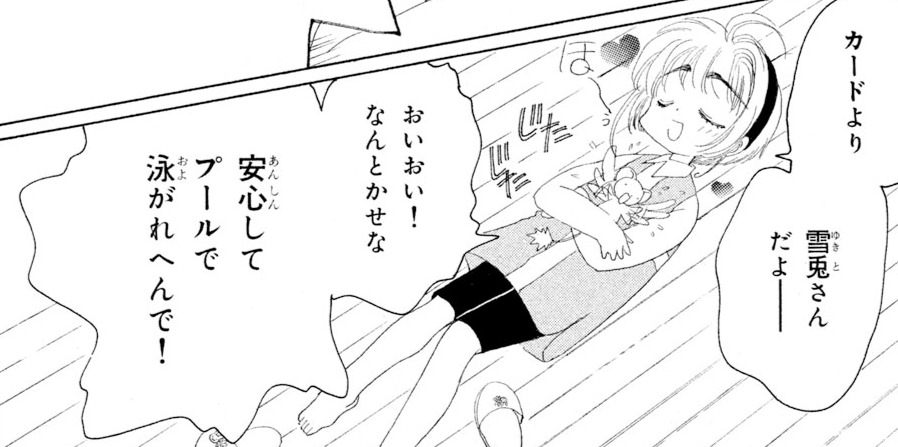
Sakura and Kero are supposed to discuss a Clow Card causing problems at the elementary school school. After taking her homemade pancakes to her brother and Yukito, Sakura’s happiness over making something for Yukito overtakes her concern of Clow Cards. Kero tries to get her back on track.
- 桜:
- 「カードより雪兎だよーーー」
- “Forget the cards, Yukito's way more important!”
- Literal: “It's Yukito more than the cards!”
- ケロ:
- 「おいおい!なんとかせな」
- “Hey hey! You've gotta do something about it!”
- 「安心してプールで泳がれへんで!」
- “The pool can't be swam in safely!”
Key Points
1泳がれへん means “won’t be able to swim” in Kero’s Kansai speech
- The common-language equivalent is 泳げない, the negative potential form of 泳ぐ.
- Here it describes what the trouble at the school pool will prevent, not Sakura’s swimming ability in general.
2なんとかせな means “we’ve got to do something about it”
- This is a clipped Kansai obligation. Compare common-language なんとかしなければ or なんとかしないと.
- The rest, such as あかん “it won’t do”, is left unsaid because the need to act is already clear.
3安心して describes how someone would swim
- In 安心してプールで泳ぐ, the て-form means “swim feeling at ease”.
- プールで marks the pool as the place where the swimming happens.
4Sentence-final で gives Kero’s warning a push
- This Kansai で works much like common-language よ here. Kero is pressing the consequence on Sakura.
5カードより雪兎だ puts Yukito ahead of the cards
- カードより sets “the cards” as the comparison baseline. Sakura leaves the scale unstated, but her meaning is that Yukito matters more.
Vocabulary
安心 (Peace of mind)
安心 means peace of mind or relief from anxiety. It describes feeling that there is no longer a reason to worry.
See Also
- Grammar: Negation with 〜ない
- Grammar: Grammar in the Kansai dialect
- Future entry: Able to do with 〜れる・〜られる
- Grammar: Must do with 〜なければならない
- Future entry: Than, more, and from with より
- Grammar: Connecting actions with 〜て・〜で
- Grammar: Negation with 〜ない
- Future entry: Informing with よ
- Kanji: Peace and ease with 安
カードキャプターさくら © its respective creators. It is used here for educational commentary.