Not all that fun with それほど〜ない
Grammar Explanation: Not as much as with 〜ほど〜ない
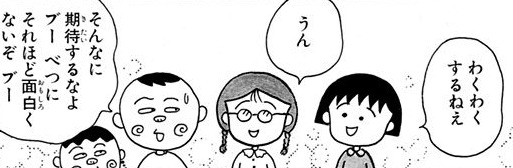
Bootaro has started going to church with a relative. He told Maruko and Tama-chan it was pretty fun, with hymns, picture-story shows of Bible stories, and snacks. Maruko, mostly interested in the snacks, decided to go too, and Tama-chan came along. On Sunday the two meet Bootaro outside the church.
- まる子:
- 「わくわくするねえ」
- “This is so exciting!”
- たまちゃん:
- 「うん」
- “Yeah.”
- ブー太郎:
- 「そんなに期待するなよブー べつにそれほど面白くないぞブー」
- “Don't get your hopes up that much, boo. It's not all that fun, boo.”
Key Points
- Aほど〜ない means “not as ~ as A”. When A is それ, “that”, the yardstick is whatever degree is being talked about. Here it is the fun Maruko and Tama-chan are expecting.
- それほど面白くない means “not all that fun”. Church is still somewhat fun, just less than they imagine. Earlier he told them it was けっこうおもしろい, “pretty fun”, so he isn’t taking that back.
- ほど needs the negative to make this comparison. Here it is the ない in 面白くない.
- Verb + な is the prohibitive form, a blunt “don’t”. 期待するな is “don’t expect” or “don’t get your hopes up”.
- そんなに means “that much” or “so much”, pointing at the girls’ excitement after Maruko’s わくわくするねえ.
- よ after な softens the order a little and makes it sound like friendly advice.
- べつに with a negative means “not particularly”. It makes his statement even more low-key: “it’s not, you know, all that fun”.
- ぞ is a rough, mostly masculine sentence ending that asserts something to the listener. It makes his warning sound firm.
- ブー is Bootaro’s verbal tic. He ends many of his lines with it, and it adds no meaning.
- わくわく describes a heart racing with excitement or anticipation. わくわくする is “to be excited”, and ねえ invites Tama-chan to agree.
Vocabulary
わくわく (Excited)
わくわく describes a heart racing with excitement or anticipation.
する (To do)
する is to do or perform something. It also turns many nouns into verbs, as in 勉強する.
そんなに (That much)
そんなに describes a degree like the one just mentioned. With a negative, it means “not that much”.
べつに (Not particularly)
べつに is the kana spelling of 別に. With a negative, it means “not particularly” and makes a statement more low-key.
それほど (Not all that)
それほど means “to that degree”. With a negative, it means “not all that” or “not especially”.
See Also
- Grammar: Not as much as with 〜ほど〜ない
- Grammar: The prohibitive な
- Grammar: Rough declarations with ぞ and ぜ
- Grammar: Informing with よ
- Future entry: Demonstrative expression with こそあど
- Kanji: Faces and surfaces with 面