Not as good as you say with 口でいうほど〜ない
Grammar Explanation: Not as much as with 〜ほど〜ない
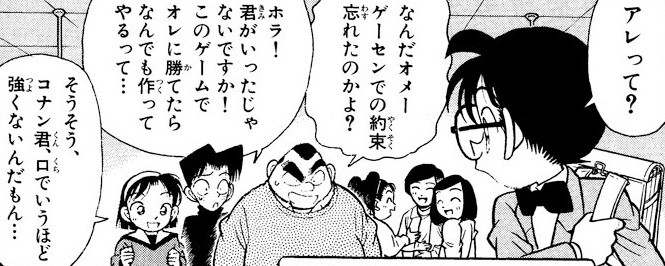
At Teitan Elementary, Genta asks Conan whether the thing he promised them should be ready by now.
- コナン:
- 「アレって?」
- “What thing?”
- 元太:
- 「なんだオメー ゲーセンでの約束忘れたのかよ?」
- “What, you forgot the promise you made at the arcade?”
- 光彦:
- 「ホラ! 君がいったじゃないですか! このゲームでオレに勝てたらなんでも作ってやるって…」
- “Come on! You said it yourself! 'If you can beat me at this game, I'll make you anything you want...'”
- 歩美:
- 「そうそう、コナン君、口でいうほど強くないんだもん…」
- “That's right. Because you're not as good as you said you were, Conan...”
Key Points
- Aほど〜ない means “not as ~ as A”. Here A is a clause, 口でいう, “what you say”. Conan’s claim is the yardstick, and 強くない says his real skill falls short of it.
- 口で言う is literally “to say with your mouth”. It contrasts words with what someone can actually do.
- 強い is “strong”, but for games and sports it means “good” or “hard to beat”.
- もん comes from もの and gives a reason in a casual, childlike way. Ayumi backs up Mitsuhiko by explaining how they won: Conan wasn’t as good as he’d said.
- 君がいったじゃないですか is “you’re the one who said it!” Mitsuhiko uses じゃないですか to remind Conan of something he should already know. Mitsuhiko talks politely even to his friends.
- The って at the end of his line quotes Conan’s promise: このゲームでオレに勝てたらなんでも作ってやる.
- 作ってやる is “I’ll make it for you”. やる after a て-form says the speaker does something for someone of equal or lower standing. It sounds like Conan talking down to his classmates.
- オメー is a rough pronunciation of お前, “you”. 〜のかよ makes his question sound accusing: “You forgot, huh?”
- ゲーセン is short for ゲームセンター, “arcade”.
Vocabulary
アレ (That)
アレ is a katakana spelling of あれ, “that”. It often hints at something the speaker would rather not say outright.
ゲーセン (Arcade)
ゲーセン is a game arcade, a place with coin-operated video games and prize machines. It is short for ゲームセンター.
忘れる (To forget)
忘れる is to forget something. It also means to leave something behind by mistake.
ホラ (Look)
ホラ is a katakana spelling of ほら, said to call attention to something or hurry someone: “look” or “come on”.
君 (You)
君 is a word for “you” used toward equals or people younger or of lower standing. It sounds gentle or poetic. Read くん, it is a suffix on names.
この (This)
この means “this” or “these” and comes directly before a noun. It points to something near the speaker or something the speaker is referring to in the conversation.
ゲーム (Game)
ゲーム is a game, especially a video game.
オレ (I)
オレ is a katakana spelling of おれ, a casual, masculine word for “I”. It is also written 俺.
勝つ (To win)
勝つ is to win against an opponent or in a contest.
作る (To make)
作る means to create or prepare something.
やる (To do)
やる is a casual word for “to do”. It also means to give something to someone of lower standing, or to animals and plants.
口 (Mouth)
口 is the mouth. It also refers to speech, as in 口を滑らせる, to let something slip.
いう (To say)
いう is to put something into words. It is the kana spelling of 言う and appears in phrases like という, which introduces a name or a quoted idea.
ほど (Extent)
ほど is the degree or extent of something: “about” or “as much as”. 〜ば〜ほど means “the more…, the more…”.
強い (Strong)
強い describes superior strength or skill, physical or mental resilience, or an extreme degree or level of something.
もん (Because)
もん ends a sentence to give a reason, often in a childish or pouting tone. It is a casual form of もの.
See Also
- Grammar: Not as much as with 〜ほど〜ない
- Grammar: Casual reasons with 〜もん
- Grammar: Quoting and reporting with と and って
- Kanji: Making and creating things with 作
- Kanji: Strength and force with 強