Not doing it on purpose with 〜わけじゃない
Grammar Explanation: Not necessarily with 〜わけではない
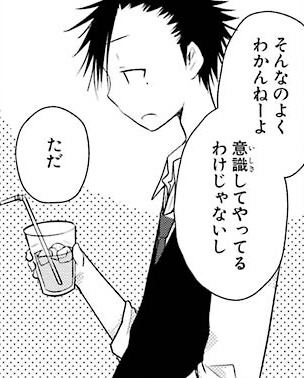
Hase suspects Kujou knows something about Fujimiya’s past, so he decides to get closer to him and takes him to a family restaurant after school. Over dinner, Kujou mentions he moved to Hokkaido for his father’s job and later came back. Hase asks whether moving bothered him, and Kujou says not really. Hase tells him he seems somehow detached, and Kujou answers, “…I wonder.” Hase asks if he’s always been like that.
- 九条:
- 「そんなのよくわかんねーよ」
- “I don't really know about that stuff.”
- Literal: “I don't really understand something like that.”
- 「意識してやってるわけじゃないし」
- “It's not like I'm doing it on purpose.”
- Literal: “It isn't the case that I'm doing it consciously, and…”
- 「ただ」
- “It's just…”
- Literal: “Only…”
Key Points
- わけじゃない is the casual form of わけではない. It rejects a conclusion the listener might draw. Hase has called Kujou detached, and Kujou heads off the idea that he acts that way deliberately.
- He doesn’t deny being detached. He denies only that it’s intentional.
- 意識して is the て-form of 意識する, “to be conscious of”. Here it works like an adverb: “consciously” or “on purpose”.
- し lists a reason, often leaving others unsaid. It explains his first line: he can’t really say whether he was always this way, since it isn’t something he does consciously.
- わかんねー comes from わからない. The ら becomes ん (わかんない), and rough speech turns ない into ねー.
- やってる is やっている with the い dropped.
- そんなの means “something like that”, pointing back to Hase’s question.
- よく with a negative means “not really” or “not well”. よくわかんねー is “I don’t really know”.
- ただ adds a qualification to what he just said. He continues in the next panel, saying that at some point he started thinking “oh well, that’s how it goes” whatever happened.
Vocabulary
そんな (Like that)
そんな describes something like the thing just mentioned. Said alone, it shows shock or denial: “no way!”
よく (Often)
よく means something happens often. It also means “well” or “skillfully”. Before 〜ね, it can show admiration or surprise.
わかる (To understand)
わかる is to understand something, or for something to become known or clear. It is also written 分かる.
意識 (Consciousness)
意識 can mean consciousness, awareness, or the act of keeping something in mind.
する (To do)
する is to do or perform something. It also turns many nouns into verbs, as in 勉強する.
やる (To do)
やる is a casual word for “to do”. It also means to give something to someone of lower standing, or to animals and plants.
わけ (Reason)
わけ is a reason or meaning. It also appears in grammar patterns such as わけがない, “there’s no way”, and わけにはいかない, “can’t very well”.
ただ (Just)
ただ describes something ordinary or nothing more than it is: “just” or “only”. It also means “free of charge”, often written タダ.
See Also
- Grammar: Not necessarily with 〜わけではない
- Grammar: How casual contractions work
- Grammar: Ongoing actions and resulting states with 〜ている
- Kanji: Thought and intention with 意