Not even an air conditioner with 〜さえ
Grammar Explanation: Even and as long as with 〜さえ
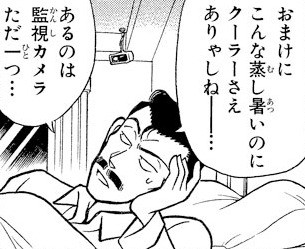
Kogoro, Ran, and Conan are guests on a Sherlock Holmes fan tour at a pension. At four in the morning, Kogoro lies awake grumbling that the room has no TV, no phone, and no newspaper.
- 小五郎:
- 「おまけにこんな蒸し暑いのにクーラーさえありゃしねー…」
- “And on top of that, it's this muggy and there isn't even an air conditioner…”
- 「あるのは監視カメラただ一つ…」
- “All we've got is one security camera…”
Key Points
- さえ means “even”. With a negative, it names the bare minimum and says even that is missing.
- Kogoro expects at least an air conditioner on a muggy night. クーラーさえ〜ねー says the room doesn’t even have that, so everything else he wants is out of the question too.
- さえ replaces が. The plain sentence is クーラーがない, and adding さえ gives クーラーさえない.
- ありゃしねー starts as ありはしない: the stem あり of ある, then は, then しない. Putting は between the stem and しない makes a blunt, emphatic negative, “there just isn’t any”.
- Two rough contractions stack on it. ありは runs together into ありゃ, and ない becomes ねー.
- In the panel before this one, Kogoro grumbles that there’s no TV, no phone, and no newspaper. おまけに, “on top of that”, adds the next complaint to the pile.
- こんな蒸し暑いのに is “when it’s this muggy”. のに sets up what you’d expect, an air conditioner, so it stings more that there isn’t one.
- あるのは turns ある into a noun with の: “what there is”. ただ一つ is “just one”.
- So あるのは監視カメラただ一つ is “the one thing there is, is a security camera”. It’s his last complaint. The room doesn’t have what he wants, but it does have the owner watching.
Vocabulary
おまけに (On top of that; to make matters worse)
おまけに adds one more point to what was just said, often one more complaint: “on top of that” or “to make matters worse”. It is common in speech and usually written in kana.
こんな (Like this)
こんな describes something like the thing in front of the speaker or the thing just mentioned.
蒸し暑い (Muggy)
蒸し暑い describes weather or a room that is hot and humid, the sticky heat of a Japanese summer.
クーラー (Air conditioner)
クーラー is an air conditioner that cools a room.
ある (To exist)
ある is to exist or be in a place, for things and plants rather than people or animals. It also means to have something, or for an event to take place.
する (To do)
する is to do or perform something. It also turns many nouns into verbs, as in 勉強する.
監視カメラ (Security camera)
監視カメラ is a security or surveillance camera, set up to keep watch over a place and the people in it.
ただ (Just)
ただ describes something ordinary or nothing more than it is: “just” or “only”. It also means “free of charge”, often written タダ.
一つ (One)
一つ is the number one when counting things that have no special counter word. 〜の一つ means “one of” a group, as in 好きな歌の一つ, “one of my favorite songs”. It is also written ひとつ.
See Also
- Grammar: Even and as long as with 〜さえ
- Grammar: Even though with 〜のに
- Grammar: How casual contractions work